Distinguished Lectures
Nuclear science and technology award recipients to deliver Distinguished Lectures at ANSTO.


Showing 1261 - 1280 of 1706 results
Nuclear science and technology award recipients to deliver Distinguished Lectures at ANSTO.
ANSTO radiocarbon facilities and scientists are featured in a new IMAX documentary film released in the United States.
Radioisotope tracing technique are used to understand the uptake of contaminants, and nutrients, bioaccumulation, by aquatic organisms and terrestrial plants.
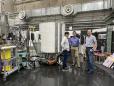
The instrument is ideally suited to study of spin and lattice dynamics, magnon and phonon dispersion relations in single crystal samples.
Research will change understanding of Australian Aboriginal rock art found in rock shelters of the Kimberley and its relationship to a changing landscape
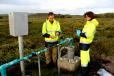
Water is a resource that needs careful management to ensure it is used sustainably. In this data set, students analyse real research data about the sustainability of groundwater on Rottnest Island.
Students will:
- understand the concepts of groundwater and aquifers and the role of the water cycle
- use MS Excel to construct simple graphs (or draw graphs by hand)
- interpret and analyse graphs and other representations of data
- investigate the effects of a changing climate on groundwater resources
- distinguish between correlation and causation
Routine transport of spent nuclear fuel
In an effort to understand why the Tongan Hunga volcano eruption was so explosive, internationally-recognised volcanologist Prof. Shane Cronin of the University of Auckland and associates rely on beamlines at the Australian Synchrotron to support comprehensive research on the Hunga event.
Following your experiment at ANSTO there are certain tasks that users can complete including a user feedback survey and claiming reimbursement for travel expenses.
2025 marks the 150th anniversary of the signing of the Metre Convention—a milestone that underscores a century and a half of international collaboration in measurement science. T

We are part of the Planetary Science community in Australia
Let your students lead a 30-minute Q&A session with our ANSTO experts about one of the following three topics:
- Nuclear medicines
- Nuclear techniques to study the environment
- Fission and its applications in reactors
Please ensure your students do some pre-reading about the research topic and come prepared with questions to ask during the session. We also ask that teachers send us a copy of the student questions the day before, so we can adequately prepare for your session. Teachers must be present during the session with their students.
Cost: Free