
Radiation Testing - Expertise
The Centre for Acclerator Science operates accelerators that can be used for space radiation testing.


Showing 141 - 160 of 513 results
The Centre for Acclerator Science operates accelerators that can be used for space radiation testing.
The National Deuteration Facility is providing deuterated cholesterol, an essential ingredient in lipid nanoparticles for the delivery of vaccines using mRNA, to academic and industry partners.

Health researchers at ANSTO use world-class nuclear and isotopic techniques to undertake research and development activities to address some of the most challenging health problems.
An Australian-led international research team, including a core group of ANSTO scientists, has found that doping a promising material provides a simple, effective method capable of extracting uranium from seawater.
Early research at ANSTO has contributed to development of innovative submicron particle encapsulation technology.
ANSTO is a unique national science organisation that began operating under its predecessor The Australian Atomic Energy Commission (AAEC) 70 years ago.
Moving earth in the search for dark matter: laboratory construction underway at mine site.
Professor Peter Lay from the University of Sydney has been awarded the Australian Synchrotron Lifetime Contribution Award by ANSTO, the Australian Nuclear Science and Technology Organisation.

Koala is one of the leading small-molecule crystallography instruments in the world for determining the complex crystal structure of a wide range of chemicals and minerals.
Hosts workshop on nuclear forensics for IAEA members.

Efficient electro-catalysis of hydrogen from seawater represents a low-cost, abundant source of clean energy.
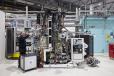
Soft x-rays are generally understood to be x-rays in the energy range 100-3,000 eV. They have insufficient energy to penetrate the beryllium window of a hard x-ray beamline but have energies higher than that of extreme ultraviolet light.
PhD candidate Vienna Wong is using her FutureNow Scholarship to research ultra-high temperature ceramics, which are emerging materials for extreme environments.


Nuclear science is crucial to understanding our universe, our world and ourselves at the atomic level. If we can understand how atoms get together, interact, or can be best combined with other atoms, new, more efficient materials and drugs can be developed.