Experiments carried out on Antarctic flight
State- of-the-art microdosimeters used in research


Showing 1501 - 1520 of 1717 results
State- of-the-art microdosimeters used in research
A team of researchers including the University of Rochester, CSIRO and ANSTO has found methane emissions from human fossil sources have been greatly underestimated.

Dr Carol Azzam Mackay is the Design and Innovation Manager at nandin, ANSTO’s Innovation Centre.

Role at ANSTO
Recommended accommodation and transport information.
The release of the Oppenheimer film, the story of the director of the Manhattan Project, has prompted many people to go online and search for an explanation of the difference between fission and fusion, two fundamental scientific concepts.
As the flagship facility of ANSTO’s Innovation Precinct at Lucas Heights, nandin recently celebrated its fifth anniversary in a special gathering held this week for its startups, businesses and innovation community.
2025 marks the 150th anniversary of the signing of the Metre Convention—a milestone that underscores a century and a half of international collaboration in measurement science. T
Insights into the behaviour of structural materials in a molten salt environment
Nuclear engineer, Robert Mardus-Hall, with his research partner Andrew Pastrello, are developing nuclear power based solutions for space missions to the Moon and Mars.
New technology is being developed in Sydney to recycle used Personal Protective Equipment (PPE) and turn it into raw materials for 3D printing.
ANSTO environmental scientists have alerted the scientific community of the critical need to monitor changes to ice containing potential nuclear fallout that reached Antarctica from 20th century atmospheric weapons testing.

Dingo sees through heavy corrosion to help dentify an historic firearm.
Groundwater experts from ANSTO and UNSW have led a collaboration of Australian and American researchers to analyse the composition of deep, very old groundwater and develop a new conceptual framework that describes the degradation of carbon over time in the subsurface.
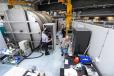
The Platypus instrument can be used to study all-manner of surface-science and interface problems, particularly related to magnetic recording materials and for polymer coatings, biosensors and artificial biological membranes.