Sydney Access Proposals
View the upcoming proposal deadlines for access to ANSTO’s Research Portal. The User Office provides support for research proposals and enables you to leverage our world-class research infrastructure and facilities.


Showing 161 - 180 of 494 results
View the upcoming proposal deadlines for access to ANSTO’s Research Portal. The User Office provides support for research proposals and enables you to leverage our world-class research infrastructure and facilities.
Research indicates that the portable x-ray fluorescence (XRF) is an appropriate analytical technique for determining seafood provenance at external sites.
Development of new techniques makes it possible to date Australian Aboriginal rock art.
New screening method developed to confirm if deuteration improves metabolic stability.
Measurement research undertaken to ensure safe, well-engineered nanoparticles
Accurate ‘fingerprinting’ tool to verify source of origin is in development with collaborators from academia and industry.
Multi-faceted approach to dating Australian Indigenous rock art from Kimberley region

Think Science! 2023 Summary and Results
An international team has published research in Nature today that identified the oldest known mummified remains of an exceptionally well-preserved terrestrial vertebrate, a 289-million-year-old reptile Captorhinus.
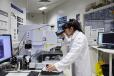
The Infrared Microspectroscopy beamline combines the high brilliance and collimation of the synchrotron beam through a Bruker V80v Fourier Transform Infrared (FTIR) spectrometer and into a Hyperion 3000 IR microscope to reach high signal-to-noise ratios at diffraction limited spatial resolutions between 3-8 μm.

Role at ANSTO

A large team of ANSTO scientists in collaboration with University of Wollongong researchers has developed a new hybrid technique that enhances the effectiveness of a cutting-edge form of radiation therapy for advanced cancer.
An environmental study supported by a citizen science project at ANSTO and UNSW has brought greater understanding of the movement of birds between all of Australia’s major water basins and the importance of the Murray-Darling River Basin.

ANSTO offers a broad range of programs and services to various industries and customers. Many of these services, including the Australian Nuclear Medicine Traceability program, are supported by online customer portals.

ANSTO has a variety of games and apps to educate students on how radiation works, nuclear medicine, the periodic table, and atom building.
A pioneering study led by Professor Junpei Yamanaka of Nagoya City University and an international team that included ANSTO has delivered transformative insights into the behaviour of colloidal particles under microgravity.
In Australia and the Southeast Asia basin, the ANSTO facility offers a wide range of unique nuclear-beam techniques for cultural heritage research.
Groundwater experts from ANSTO and UNSW have led a collaboration of Australian and American researchers to analyse the composition of deep, very old groundwater and develop a new conceptual framework that describes the degradation of carbon over time in the subsurface.