test halocell

De-risking space missions through radiation testing at ANSTO

halocell1
"Access to ANSTO’s Centre for Accelerator Science has been critical for Halocell. The ability to perform controlled, mission-relevant proton irradiation on our modules has given us direct evidence of the technology’s radiation tolerance in a low-Earth-orbit environment. Without this onshore capability and the expertise of the CAS team, we would not have been able to generate the data needed to de-risk our path toward space qualification and commercialisation. Working with ANSTO has strengthened our confidence in the performance of our flexible perovskite modules and is an important step in making Australian space solar technology globally competitive” - Leo Michael, Product Engineer - Halocell Energy.

The challenge

The space and satellite power market is growing rapidly, but existing options force a trade-off. GaAs/GaInP solar cells are expensive and have long lead times, while more economical silicon PV degrades rapidly in space conditions. Perovskite PV offers a low-cost and robust alternative. Halocell Energy is developing lightweight, flexible perovskite solar modules for space. Before pursuing flight applications, the company needed evidence that its modules could retain power after exposure to radiation in low Earth orbit (LEO). The target environment represented three-and five-year missions at an altitude of 550 km. At this altitude, electrons and protons are the predominant particles that can displace atoms within the solar-cell material and reduce electrical performance. Without representative ground testing, Halocell could not confidently assess long-term power retention. The company therefore sought testing at ANSTO to quantify damage and guide manufacturing improvements before flight.
The solution

Ryan Drury with Halocell
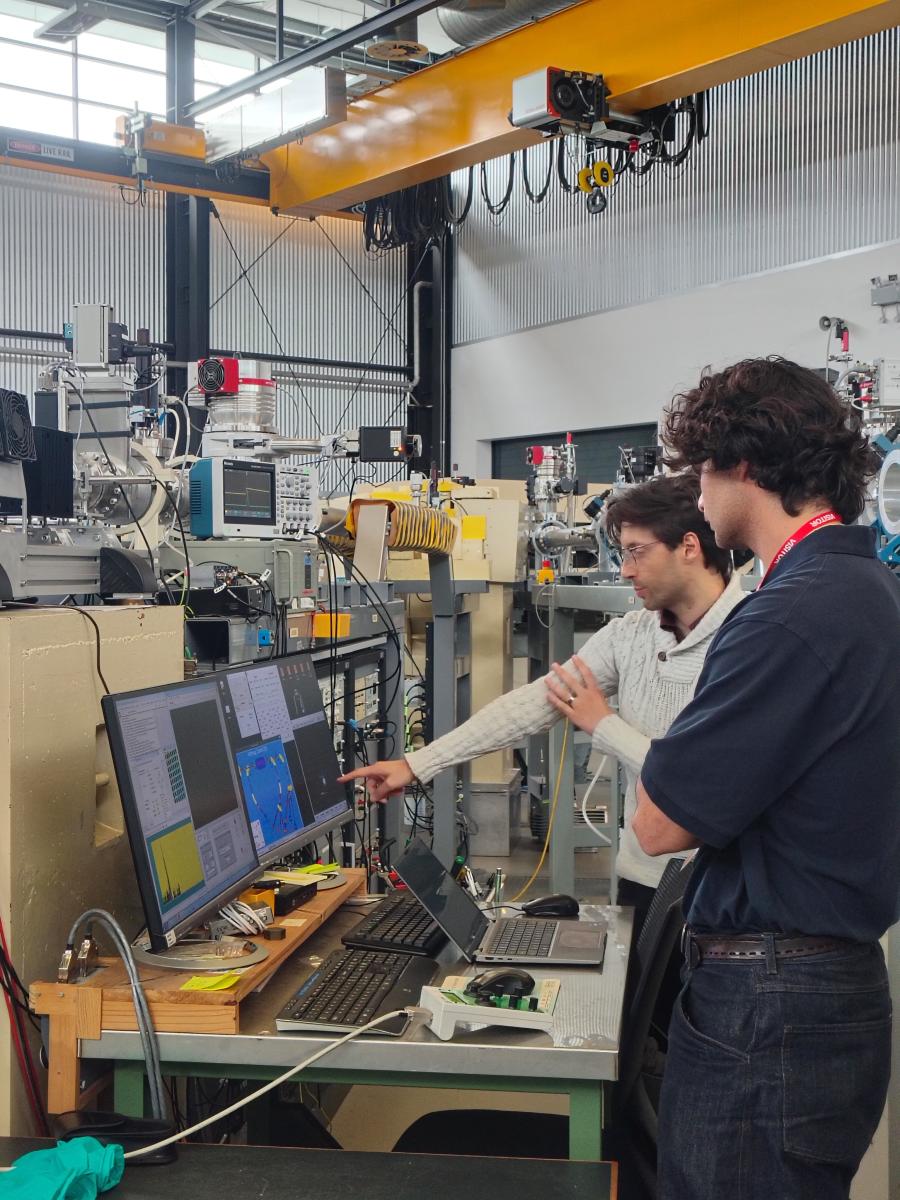
Leo Michael with Dr Ryan Drury from ANSTO Centre for Accelerator Science performing proton testing at the end station of the SIRIUS accelerator’s microprobe beamline.

ANSTO’s Centre for Accelerator Science provided controlled proton irradiation through the SIRIUS accelerator microprobe beamline, allowing Halocell to assess flexible perovskite modules under representative radiation exposure. Mission-fluence modelling linked ground testing to lifetime exposure in orbit. Using an electron-equivalent fluence methodology, proton beams were used to reproduce electron-induced exposure. The team convolved SPENVIS electron fluences for three- and five-year missions with the non-ionising energy loss (NIEL) spectrum. SRIM simulations identified 6.2 MeV protons as suitable for simulating the radiation exposure in the perovskite layer. Normalising by NIEL then gave the proton fluence for each target mission duration. Six modules were tested, three at each mission fluence, in vacuum at ambient temperature with the beam perpendicular to the sample surface. Adjusting the scanning path while maintaining fluence allowed responses to be investigated across individual cells. After irradiation, electrical performance was measured under simulated extraterrestrial sunlight (AM0) and compared with non-irradiated samples to quantify any performance loss.


The impact

Leo Michael - Halocell2
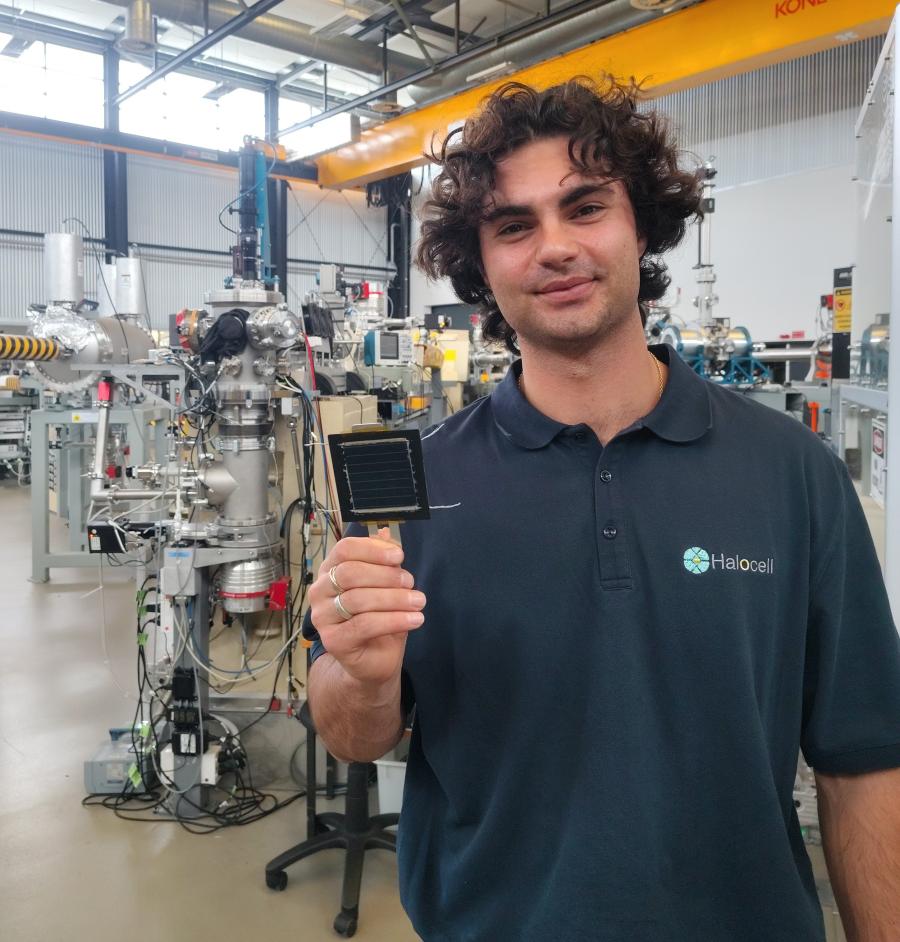
Leo Michael, Product Engineer from Halocell Energy holding their space module housing the solar cells under test.

Under AM0, average power retention was approximately 98% at 5-years LEO-equivalent fluence, and 99% at the 3-year with several modules showed no degradation or a slight improvement. Open-circuit voltage remained highly stable at both fluences. These results increase confidence in the radiation hardness of Halocell’s current cell stack for LEO applications and reduce uncertainty towards space qualification, improving its competitiveness in the space power market, where comparable data for this technology remain limited. For Halocell, the expected commercial benefits include revenue opportunities and improved productivity as test results guide product development and manufacturing decisions.


ANSTO provides a national testing capability that lets Australia’s space industry advance its technology without the cost and logistical complexity of overseas testing. Its expertise in space radiation environments supports detailed, mission-specific testing and interpretation. ANSTO also offers a voucher scheme, an NCRIS initiative that supported this test and reduces barriers for start-ups and SMEs to access national research infrastructure and specialist capabilities.

Contact

CAS Irradiations Team Lead