Accelerator mass spectrometry techniques
Accelerator Mass Spectrometry (AMS) is an ultra-sensitive analytical technique based on the use of an ion accelerator as a powerful mass spectrometer.


Showing 1 - 20 of 84 results
Accelerator Mass Spectrometry (AMS) is an ultra-sensitive analytical technique based on the use of an ion accelerator as a powerful mass spectrometer.
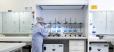
The samples preparation facilities include state-of-the-art chemistry laboratories and other specialist supporting areas
ANSTO is a partner on the National Space Qualification Network (NSQN) led by the Australian National University (ANU) that will transform Australia into a world-leading space centre by enhancing facilities to test payloads, components, and hardware prior to their use in harsh environments of space.
ANSTO is participating in a new Australian Research Council (ARC) Centre of Excellence for Indigenous and Environmental Histories and Futures (CIEHF) to be headquartered at James Cook University (JCU) that aims to bring Indigenous and environmental histories to the forefront of land and sea management.
In Part 2 of our series exploring the world of nuclear science and technology at ANSTO, we share more detailed information about the nuclear scientist’s toolkit.
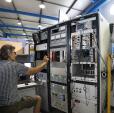
ANSTO provides multiple sources for radiation testing of materials and devices including Co-60 gamma sources, x-ray, proton and heavier ion-beams.

By submitting a proposal for Merit Access to ANSTO’s Biosciences, Centre for Accelerator Science, Isotope Tracing, Nuclear Stewardship or the Vivarium capabilities, you are agreeing to the following Terms and Conditions. These Terms and Conditions apply to external merit researchers, scientific collaborators and partners unless there is a specific agreement in place between ANSTO and the home institution of the Principal Investigator.
ANSTO's facilities in Sydney include access to neutron beam instruments, X-ray and infrared instruments, biological and chemical deuteration, accelerators, and an array of other capabilities and techniques.
This National Science Week, we're acknowledging the 2026 theme, “Seeds of Science: Nurturing knowledge for all” by celebrating the ideas, facilities and people that help scientific knowledge flourish with a series of activities.
ANSTO’s Centre for Accelerator Science has been selected as a partner facility in RADNEXT 2030, a major European initiative that provides researchers and industry with access to radiation testing infrastructure for electronics.
A team of Melbourne researchers and international partners from Italian Instituto Nazionale de Fisica Nucleare (INFN) and CERN, who are developing radiation-hardened semiconductor chips, used the unique state-of-art high energy ion microprobe on the SIRIUS ion accelerator at ANSTO’s Centre for Accelerator Science to test a prototype radiation-resistant computer chip
More than 3,200 solar panels have been installed across the rooftops of the Australian Nuclear Science and Technology Organisation’s (ANSTO) Australian Synchrotron in Clayton, offsetting enough power to light up the whole MCG for more than five years.
A research team from ETH Zurich developing and characterizing silicon carbide devices for power electronics, recently spent time at ANSTO’s Centre for Accelerator Science to use a specialised beamline in their investigations.
A new radiocarbon dating facility opened at the University of New South Wales (UNSW) will complement the extensive radiocarbon facilities at ANSTO’s world-leading Centre for Accelerator Science
ANSTO renewed its Memorandum of Understanding (MOU) with the Japan Proton Accelerator Research Complex (J-PARC) operated by the High Energy Accelerator Research Organisation (KEK) and Japan Atomic Energy Agency (JAEA). Now broadened to include their partner Comprehensive Research Organization for Science and Society (CROSS), the signing took place early in the year and a celebratory workshop was held late July.
View the upcoming proposal deadlines for access to ANSTO’s Research Portal. The User Office provides support for research proposals and enables you to leverage our world-class research infrastructure and facilities.

ANSTO has a range of capabilities and expertise to support aerospace and space research.
Dr Ceri Brenner appointed new leader of the Centre for Accelerator Science