What is radiation?
Radiation can be described as energy or particles from a source that travel through space or other mediums. Light, heat, and wireless communications are all forms of radiation.


Showing 1 - 20 of 90 results
Radiation can be described as energy or particles from a source that travel through space or other mediums. Light, heat, and wireless communications are all forms of radiation.
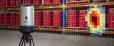
CORIS360 delivers fast, accurate radiation detection and imaging, making invisible radiation visible to improve safety and decision making in radioactive environments.
Radioisotopes are widely used in medicine, industry, and scientific research. New applications for radioisotopes are constantly being developed.
Stage 1 of the Stawell Underground Physics Laboratory was officially opened today. It will be home to multi-disciplinary scientists from five research partners who help us understand dark matter.
Discover the amazing world of nuclear science from your classroom. Join us for Meet an Expert, Nuclear Science Inquiry Skills, Junior Science, and Online Depth Study sessions for Chemistry, Physics and Investigating Science.
Role at ANSTO
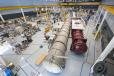
The Australian Centre for Neutron Scattering (ACNS) is a major research facility for neutron science that comprises a suite of neutron instruments with a range of techniques for scientific investigations in physics, chemistry, materials science, medicine and environmental science among other fields.
ANSTO launches new area of space research in collaboration with the National Centre for Space Studies and the National Institute of Health and Medical research in France.
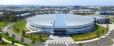
Synchrotron light is the electromagnetic radiation emitted when electrons, moving at velocities close to the speed of light, are forced to change direction under the action of a magnetic field.
Frequently asked questions about beamtime, accommodation and the user portal.
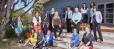
Read about an ANSTO scientist and their work to prepare for a school project or interview.
ANSTO provides secondary students with a range of learning resources for those interested in science or studying for exams. For teachers, ANSTO provides learning resources and professional development, as well as in-school-term science tours and videoconferences. Workbooks are provided as required learning material to accompany a school visit to ANSTO. They can also be used on their own as a classroom resource.
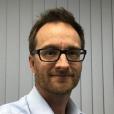
ANSTO, as the Australian centre for nuclear-related research and as the custodian of large research infrastructure is well-positioned to undertake research on molten sale based reactor systems using its capabilities and expertise.
Blake Orr from ARPANSA review the Netflix series Radioactive Emergency.

Guide to successful proposals and experiments at the Powder Diffraction beamline.