Deuteration supports blood test to help diagnose breast cancer
The National Deuteration Facility has supplied deuterium labelled lipids to quantify lipid biomarkers in a blood test to help diagnose breast cancer.


Showing 21 - 40 of 44 results
The National Deuteration Facility has supplied deuterium labelled lipids to quantify lipid biomarkers in a blood test to help diagnose breast cancer.

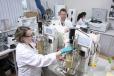
The National Deuteration Facility offers the facilities and expertise to produce molecules where all or part of the molecular hydrogen is replaced with deuterium. This enables complex investigations of the relationship between the structure of molecules and their function using neutron scattering and other techniques.

Links to all previous news and case studies published by the National Deuteration Facility
ANSTO’s National Deuteration Facility has provided deuterated cholesterol for international research to gain a better understanding of how the Spike protein of the COVID virus, SARS-Co-V-2, infects human cells through a membrane fusion mechanism.
ANSTO’s National Deuteration Facility has been providing high-quality deuterated lipids used in the construction of cell membrane models to support research that improves our understanding of how the virus interacts with elements of the cell membrane, a relatively new area of investigation.


ANSTO's facilities in Sydney include access to neutron beam instruments, X-ray and infrared instruments, biological and chemical deuteration, accelerators, and an array of other capabilities and techniques.
ANSTO has contributed to a recent publication in Nature Communications Biology that represents a landmark achievement in structural biology, an understanding of protein regulation mechanisms in Mycobacterium tuberculosis (Mtb), a global health threat.

Explore ANSTO's range of publications and reports available for the public.
A collaboration of scientists from RMIT, ANSTO and the CSIRO has published pioneering research that brings new insights into intrinsically disordered proteins and protein regions (IDPs)/ (IDRs) and how they behave under various physiological processes.
ANSTO is privileged to be home to an incredible array of outstanding women in science. On the International Day of Women and Girls in Science we wanted to thank each one. Thank you!

ANSTO provides access to specialised facilities and capabilities by application. Please ensure that you contact the relevant ANSTO scientist for advice before submitting a proposal.

ANSTO has agreed to participate in an Australian trial of a review of research infrastructure access proposals in which applicants remain anonymous to aid the removal of structural barriers to the career progression of Women in STEM.