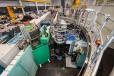
Pelican - Time-of-Flight Spectrometer
The instrument is designed to measure inelastic neutron scattering, or do neutron spectroscopy.


Showing 221 - 240 of 1252 results
The instrument is designed to measure inelastic neutron scattering, or do neutron spectroscopy.
Your efforts are helping better manage our wetlands and waterways, and protect the precious wetland birds that rely on them.
This science week ANSTO is releasing a new way for students across Australia to learn about the periodic table of elements with augmented reality (AR). ANSTO's Free AR experience unlocks the periodic table to reveal a world of protons, neutrons and electrons and illustrates how useful they are to science and industry in the 21st century.
ANSTO and the Australian Radiation Protection and Nuclear Safety Agency (ARPANSA) have been recognised for their valuable contributions to the search and recovery efforts for a missing 8mm-long radioactive capsule in the Western Australian outback.
Atmosphere scientists find link between indigenous weather knowledge and Sydney air pollution.


Challenge your understanding of nuclear science and technology with fun secondary school activities, exciting competitions and unique tours of our facilities.
The Graduate Institute is part of ANSTO’s Innovation Precinct and links all graduates together to create a network of Australia’s brightest young minds focused on the future.
Research has revealed the Lapita cultural group interacted with the indigenous people of Papua New Guinea more than 3,000 years ago and set the stage for the peopling of the Pacific
Dr Emily Finch, Microscopy Group Manager at the Australian Synchrotron, has been selected among fourteen up-and-coming leaders of Australian science to participate in Australian Academy of Technological Sciences and Engineering (ATSE) Emerging Leaders Network 2026 which supports high-potential rising professionals in STEM.
Australian and international researchers have used ANSTO’s Australian Synchrotron to confirm the presence of an unusual diamond found in stony meteorites.
Rare earth elements will be a key area of focus for the Australian Nuclear Science and Technology Organisation’s Minerals unit as it welcomes a $13.9 million funding allocation under the Australian Critical Minerals Research and Development Hub
Dr Mathew Johansen, an environmental scientist at ANSTO, presented in an online IAEA training workshop on Advanced Topics in Radiochemistry Techniques this week.
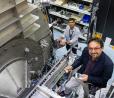
The QUOKKA instrument provides the powerful technique of small-angle neutron scattering which can look at sizes and structures of objects on the nanoscale including soft matter.