


Showing 321 - 340 of 657 results

Privacy Policy
Australian Nuclear Science and Technology Organisation (ANSTO) is committed to protecting your personal information in accordance with the Privacy Act 1988 (Cth) (Privacy Act) and the Australian Privacy Principles.
Rhodium nanoparticles
Successful synthesis of nano-material that improves catalytic converter efficiency.
ANSTO Air quality monitoring in the Port Kembla area
New technique to improve global climate models
An investigation that set out to resolve some of the uncertainty in the sources and quantities of pollutants reaching Antarctica has produced a new experimental technique to identify and characterise recently terrestrially-influenced air reaching Antarctica.
Queensland reef scientist wins new award for erosion research
Today Dr Jenine McCutcheon from the University of Queensland’s School of Earth and Environmental Sciences has been recognised for her outstanding research with the Australian Synchrotron's Stephen Wilkins Medal.
Structural studies of silk
New infrared imaging technique reveals molecular orientation of proteins in silk fibres
What's new in nuclear power technologies
It's ANSTO's role to keep Australia across the very latest developments in nuclear science and technology from around the world. Part of this responsibility is keeping us abreast of the latest developments in nuclear power technologies.
Prime Minister announces funding for Precision Medicine
Whilst at ANSTO’s Australian Synchrotron today, Prime Minister Scott Morrison announced new funding for the Australian Precision Medicine Enterprise (APME) Project. The Australian Government will contribute $23m in grant funding under the Manufacturing Collaboration Stream of the Modern Manufacturing Initiative (MMI) towards the $71.2m project.
Advanced imaging techniques provide earliest evidence of fruit-eating by ancient bird
International palaeontologists have used advanced imaging techniques at ANSTO’S Australian Synchrotron to clarify the role that the earliest fruit-eating birds of the Cretaceous period may have had in helping fruit-producing plants to evolve.
Fine-tuning chemistry for advanced materials
Doping with transition metals produced stability in bismuth oxide.
Fine-tuning chemistry
Doping with transition metals produced stability in bismuth oxide.
Innovative cancer research
An ANSTO radiochemist has been awarded a scholarship to carry out research at the world-renowned Sloan Kettering Cancer Center in New York.
Some of Sydney’s best science teachers meet its best science infrastructure
Accelerator Systems Overview
Certificate of appreciation from WA DFES
ANSTO and the Australian Radiation Protection and Nuclear Safety Agency (ARPANSA) have been recognised for their valuable contributions to the search and recovery efforts for a missing 8mm-long radioactive capsule in the Western Australian outback.
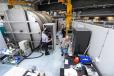
Platypus - Neutron Reflectometer
The Platypus instrument can be used to study all-manner of surface-science and interface problems, particularly related to magnetic recording materials and for polymer coatings, biosensors and artificial biological membranes.
Strong collaborations bring success for ceramic engineering scientist
Dr Inna Karatchevtseva, who collaborates with DMTC, was among those identified by The Australian in its Research magazine as a national leader in her field of ceramic engineering

Atmospheric Physicist
Role at ANSTO
Black carbon detection technology launched commercially
The Multi-wavelength absorption black carbon instrument (MABI), a technology designed and built at ANSTO to measure black carbon in the atmosphere is now commercially available from Thomson Environmental Systems.