ANSTO Innovation Precinct briefing for NSW Parliament
ANSTO shared plans for an Innovation Precinct in southern Sydney at a breakfast event.


Showing 41 - 60 of 948 results
ANSTO shared plans for an Innovation Precinct in southern Sydney at a breakfast event.
ANSTO has been awarded a Community Recognition Statement from the NSW State Parliament for hosting an event to launch a new Dharawal language learning resource for preschool and primary-aged students.
ANSTO is privileged to be home to an incredible array of outstanding women in science. On the International Day of Women and Girls in Science we wanted to thank each one. Thank you!
The nandin Deep Technology Incubator at ANSTO’s Lucas Heights innovation precinct has welcomed two new members.
Advanced X-ray techniques have revealed new structural details about the specific arrangement of atoms in conjugated polymers, an important class of materials that are used in LEDs, organic solar cells, transistors, sensors and thermoelectric power devices.
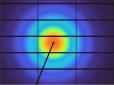
The Biological Small Angle X-ray Scattering beamline will be optimised for measuring small angle scattering of surfactants, nanoparticles, polymers, lipids, proteins and other biological macromolecules in solution. BioSAXS combines combine a state-of-the-art high-flux small angle scattering beamline with specialised in-line protein purification and preparation techniques for high-throughput protein analysis.
In a world-first study, Australian environmental scientists have used cave stalagmites as a record of groundwater replenishment over time, that showed the current level of rainfall recharging groundwater in southwest WA is at its lowest for at least the last 800 years.
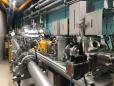
The Medium Energy- X-ray Absorption Spectroscopy beamlines provides access to XANES and EXAFS data from a bending magnet source, optimised for cutting-edge applications in biological, agricultural and environmental science in an energy range that is not currently available at the Australia Synchrotron.
A large group of ANSTO environmental scientists and collaborators have produced the first groundwater stable isotopes, ‘isoscapes’, intuitive maps with grid data, across NSW combining new and pre-existing isotope measurements.
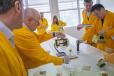
Students investigate the production of nuclear medicines in the OPAL multipurpose reactor, the use of nuclear medicines to diagnose and treat disease, and the science behind working safely with radiation.
This program is designed to address content and skill outcomes in the Year 9 and Year 10 Science Australian Curriculum and NSW syllabuses.
Cost: $90 per class.
ANSTO Physicist Andrew Smith collaborates with international scientists to study historical greenhouse gas concentrations from Antarctic ice core samples.
This data set contains temperature records and concentrations of carbon dioxide and methane from the last 800,000 years.
In a new study published in Nature Communications, researchers from UNSW have demonstrated a more sustainable alternative: an electrochemical pathway that couples carbon dioxide and nitrogen-containing species to produce urea under mild conditions.