
Research and development
Our research group carries out fundamental research uniquely applied to industrial problems in the areas of uranium, rare earth and lithium processing.


Showing 481 - 500 of 1221 results
Our research group carries out fundamental research uniquely applied to industrial problems in the areas of uranium, rare earth and lithium processing.
Your efforts are helping better manage our wetlands and waterways, and protect the precious wetland birds that rely on them.
Bushfires in proximity to ANSTO during the 2018 bushfires.
Event held to mark anniversary of SPRing-8 in Japan.

ANSTO provides secondary students with a range of learning resources for those interested in science or studying for exams. For teachers, ANSTO provides learning resources and professional development, as well as in-school-term science tours and videoconferences. Workbooks are provided as required learning material to accompany a school visit to ANSTO. They can also be used on their own as a classroom resource.
One of ANSTO’s most accomplished scientists and internationally recognised energy researchers, Prof Vanessa Peterson, has been awarded the Nancy Millis Medal for Woman in Science by the Australian Academy of Science this week.

Sample environments, Data Analysis, Mail-in Services.

ANSTO provides a summary of waste production and consumables for FY2024 - FY2025

Guide to successful proposals and experiments at the Powder Diffraction beamline.
ANSTO is participating in a major project to learn more about an important component of the atmosphere, the hydroxyl radical.
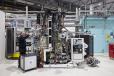
Soft x-rays are generally understood to be x-rays in the energy range 100-3,000 eV. They have insufficient energy to penetrate the beryllium window of a hard x-ray beamline but have energies higher than that of extreme ultraviolet light.

Over the last decades, neutron, photon, and ion beams have been established as an innovative and attractive investigative approach to characterise cultural-heritage materials.
Research reveals that strong westerly winds weaken the Southern Ocean’s ability to store carbon and thereby contribute to faster accumulation of carbon dioxide in the atmosphere