ANSTO scientists will participate in three new ARC Industrial Transformation Training Centres
ANSTO scientists are participating investigators in three new ARC Industrial Transformation Training Centres, recently announced by the Government.


Showing 641 - 660 of 1705 results
ANSTO scientists are participating investigators in three new ARC Industrial Transformation Training Centres, recently announced by the Government.

In accordance with the Trust Deed, the United Uranium Scholarship is awarded to ‘promising young scientists’ from any Australian organisation or institution whose research or work is in the field of nuclear energy.
ANSTO and the National University of Singapore have signed an agreement to enable Singapore researchers to access ANSTO’s state-of-the-art beamline facilities at the Australian Synchrotron.
Letter to Editor of the Sydney Morning Herald following publication of news report
Connect with the businesses and organisations seeking better understanding decommissioning oil and gas infrastructure and the potential impact of contaminants on marine life.
Shift in the treatment of blood cancers taking place.
ANSTO’s OPAL multi-purpose research reactor at Lucas Heights has officially returned to power and recommenced operations, following a months-long planned shutdown to carry out essential maintenance and upgrades.
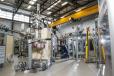
ANSTO has been using Ion Beam Analysis (IBA) techniques to analyse fine particle pollution samples collected from key sites around Australia, and internationally, for more than 20 years.
An accomplished international photographer has capture dazzling new images of one component of the main ring at our Australian Synchrotron and provided an inside view of the electron’s path when it is used.
In a new study published in Nature Communications, researchers from UNSW have demonstrated a more sustainable alternative: an electrochemical pathway that couples carbon dioxide and nitrogen-containing species to produce urea under mild conditions.
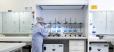
The samples preparation facilities include state-of-the-art chemistry laboratories and other specialist supporting areas
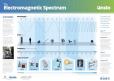
This poster shows how ANSTO utilises different parts of the electromagnetic spectrum for environmental and medical research.
The nature of Metal-Oxide-Semiconductor Field Effect Transistors (MOSFETs) present a fascinating paradox in space exploration. Their strength in radiation detection becomes their weakness in space operations, exposing an Achilles' heel for NASA. Yet, these same devices monitor radiation doses received by humans on earth and in space.
MABI instrument can determine both the concentration and source of black carbon pollution in the atmosphere.
ANSTO physicist will gain further experience in particle therapy technologies.