

Showing 741 - 760 of 1171 results
Connecting bright STEM graduates with industries drives innovation
ANSTO, Australia’s knowledge centre for nuclear science and technology, connects STEM graduates with industry to work on real-world challenges through its FutureNow Scholarships for 2022.
Nuclear medicine production at ANSTO
Media statement from ANSTO.
Distinguishing black carbon sources
MABI instrument can determine both the concentration and source of black carbon pollution in the atmosphere.
IAEA appointment
ANSTO Head of Research Dr Suzanne Hollins has been appointed to chair IAEA group on nuclear applications.
Research on nickel
Study reveals that properties of polycrystalline materials can be derived from microscopic single crystal samples
ANSTO helping to ensure the safety of astronauts in space
A team of ANSTO health researchers, staff at the Centre for Accelerator Science and Dr Melanie Ferlazzo, a postdoc from the French National Institute of Health and Medical Research (INSERM), and scientists from the French Space Agency (CNES), are collaborating on investigations to determine the impact of secondary particles on human cells using the new microprobe beamline at ANSTO’s Centre for Accelerator Science.
Jarosite on Earth and Mars
Useful in some mineral processes but a major problem in others, jarosite may be the key to unlocking the geological history and environmental context of water on Mars.
Surfing at the atomic scale: ANSTO scientists confirm experimentally new fundamental law for liquids
The first experimental evidence to validate a newly published universal law that provides insights into the complex energy states for liquids has been found using an advanced nuclear technique at ANSTO.
Fine particle pollution peaks during bushfires
Recent catastrophic Australian bushfires produced extremely high levels of fine particle pollution.
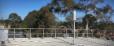
Radiation Monitoring
ANSTO continually monitors environmental gamma radiation from a station located in Engadine NSW. ANSTO uses environmental radiation data to evaluate atmospheric dispersion from its site. This radiation is almost completely natural background radiation.
ANSTO contributes to international project to evaluate economics of Small Modular Reactors
ANSTO contributes to new international project to improve how the world assesses the economic viability of Small Modular Reactors

Data disclaimer
Award for Commercial Acumen
Glacial study grant includes ANSTO
ANSTO’s unique capabilities in cosmogenic nuclides included in glacial study grant.

A robust mixed metal-organic framework for CO2 absorption and conversion
Radiocarbon dating and stable isotope analysis contribute to Antarctic research
Study shows for the first time that vegetation in the Windmill Islands, East Antarctica is changing rapidly in response to a drying climate.
MOU formalises cooperation with Vietnamese nuclear agencies
Discussions were held on possible areas on cooperation including research reactor operation and utilisation, environmental monitoring of mining tails, and food provenance.
Determining the extent of soil erosion on a NSW vineyard
Powerful new microscope a game changer in battle against disease
The Titan Krios cryo-electron microscope reveals the inner workings of life at the cellular level.