
Frequently Asked Questions
Frequently asked questions about the ANSTO Security Process, travel funding, ANSTO Research Portal and ACNS Customer Portal.


Showing 761 - 780 of 973 results
Frequently asked questions about the ANSTO Security Process, travel funding, ANSTO Research Portal and ACNS Customer Portal.
Study shows for the first time that vegetation in the Windmill Islands, East Antarctica is changing rapidly in response to a drying climate.



ANSTO has secured a $1.62 million Medical Research Future Fund (MRFF) grant under the Australian Brain Cancer Mission’s 2024 Brain Cancer Discovery and Translation program, administered by the Department of Health and Aged Care.
Nuclear security experts and officials from Australia’s nuclear agencies have convened at the International Atomic Energy Agency’s (IAEA) headquarters in Vienna, Austria last week for the International Conference on Nuclear Security (ICONS).
Research has demonstrated that internally generated neutrons could be used to effectively target micro-infiltrates and cancer cells outside of the defined treatment regions.

ANSTO's Minerals team provides consultancy, process development and research services to the mining and minerals processing industries.

Applications and Publications
Doping with transition metals produced stability in bismuth oxide.
Doping with transition metals produced stability in bismuth oxide.
Wolfgang Kubicki, MdB and a small delegation visited to see the Spatz neutron instrument donated by Helmholtz Zentrum Berlin (HZB) and discuss research.
The Hungarian Ambassador to Australia and a small delegation visited ANSTO for a special ceremony to mark the installation and commissioning of two new nuclear medicine scanners from the Hungarian company Mediso Pacific.


Nuclear-based energy generation systems not only provide comparatively low-cost, low-carbon emission electricity but also provide substantial amounts of process heat.
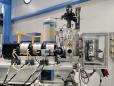
The high-energy heavy-ion microprobe is used for the characterisation or modification of material properties at depths from approximately 1 micrometre to maximum depths of up to 500 micrometres from the material surface.