Microprobe Capabilities
Irradiations
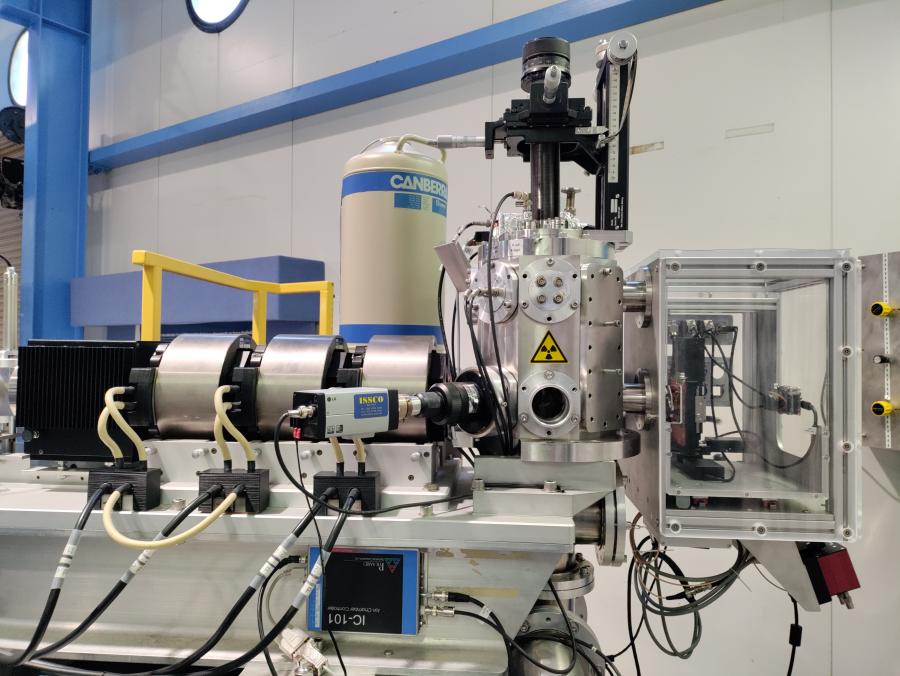
The ion microprobes on the ANTARES and SIRIUS accelerators provide highly controlled, spatially resolved irradiation capabilities for studying radiation effects in electronics, materials and biological systems. By focusing ion beams to micrometre-scale spot sizes, they enable precision irradiation of selected regions within devices, materials or cells, allowing investigations of localized radiation responses and damage mechanisms.
The microbeam irradiation capability supports radiation effects testing of microelectronic devices and integrated circuits, including single-event effects (SEE) studies, fault localization, and the characterization of radiation-induced failure mechanisms. Precise beam positioning, ion counting and single-ion detection capabilities enable deterministic single-ion and low-fluence irradiations, supporting advanced investigations of device sensitivity and the development of radiation-hardened technologies.
For materials research, the microprobes are used to investigate radiation damage processes relevant to space, defence and nuclear applications. The capability to deliver well-defined ion species, energies and fluences enables displacement damage dose (DDD) studies and accelerated testing of materials exposed to harsh radiation environments. These capabilities are particularly valuable for assessing radiation-induced degradation in structural materials, semiconductor devices and space photovoltaic technologies, including solar cells, where ion irradiations can reproduce the particle damage accumulated during long-term mission operation. A key strength of the ANSTO microprobes is the versatility provided by advanced scanning and irradiation modalities developed in-house, enabling customised irradiation patterns, targeted exposure of selected regions, high-precision dose delivery, and complex irradiation protocols tailored to specific research and testing requirements.
In radiobiology, the microbeam enables targeted irradiation of individual cells, cellular components or defined cell populations, providing unique opportunities to study DNA damage, cellular response pathways, bystander effects and other fundamental biological processes. Combined with high spatial accuracy and precise dose delivery, these capabilities support mechanistic investigations that are not possible with conventional broad-beam irradiation techniques.
Depending on the application, irradiations can be performed using either low-current single-ion delivery for deterministic targeting studies or higher-current beams for accelerated damage accumulation, DDD testing and statistically significant radiation effects experiments.
Ion Beam Analysis (IBA)
The ion microprobe is particularly useful for analysing materials with complex microstructures. Its high-resolution scanning ion beam enables the investigation of variations in elemental composition, electronic properties and material structure on the micrometre scale. By combining the two-dimensional (2D) spatial resolution of the microbeam with the depth sensitivity of ion beam analysis (IBA) techniques, three-dimensional (3D) compositional and structural characterisation can be achieved.
The ANSTO microprobes support a comprehensive suite of microbeam IBA techniques. Low-current operation enables scanning transmission ion microscopy (STIM), secondary electron microscopy (SEM) and ion beam induced current (IBIC) microscopy, providing information on material structure, surface morphology and device performance. High-current operation supports particle-induced X-ray emission (PIXE), Rutherford backscattering spectrometry (RBS), nuclear reaction analysis (NRA), elastic recoil detection analysis (ERDA) and forward scattering, enabling elemental mapping, compositional analysis and depth profiling.
The temporal dimension can be added through pulsed ion beams and single-ion detection, allowing deterministic single-ion implantation and studies of dynamic processes following individual ion impacts. Microbeam capabilities are broadly divided into low-current operation for single-ion studies and high-resolution imaging, and high-current operation for rapid, high-sensitivity elemental and structural characterisation. The achievable beam current depends on the required spatial resolution, with smaller beam spot sizes requiring lower currents and longer acquisition times.