ANSTO has agreed to participate in an Australian trial of a review of research infrastructure access proposals in which applicants remain anonymous to aid the removal of structural barriers to the career progression of Women in STEM.

Radiochemist, Manager of Radiopharmaceuticals
Role at ANSTO
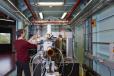
Multi-million dollar Australian Cancer Research Foundation (ACRF) Detector launched at the Australian Synchrotron,
Laboratory Technical Officer
Role at ANSTO
Iveta provides technical support and maintains the laboratories.
Background

Senior Scientist - MX
Role at ANSTO
The ARC Centre of Excellence (CoE) for Green Electrochemical Transformation of Carbon Dioxide, GETCO2, will support innovative approaches to carbon capture.

Research Leader, ANSTO and CEO of GaiaPOD. Particle physicist. Entrepreneur. Inventor. Science realist and Superstar of STEM.
Dr Safavi-Naeini is the Acting Leader of the Centre for Accelerator Science. She is a particle physicist and previously had a role as a research leader at the Human Health group.

Masters of Design Student - Swinburne University
Terry has studied in Singapore and Australia, focusing on teaching design. He is passionate about cross-cultural interactive learning and design research to inspire new and innovative concepts.

Beamline scientist
Role at ANSTO
The growth and incorporation of graphene into semiconductor device architectures has been limited by challenges related to the quality, reproducibility, and high process temperatures required to grow it on suitable substrates.

Laboratory Co-ordinator, NSTLI Biosciences
Role at ANSTO
Geetanjali helps maintain the laboratories and provides technical support to researchers.
Principal Consultant
Dr.
Board Member
Rear Admiral Richards served in the Royal Australian Navy for over 36 years, bringing extensive experience in engineering, operations, strategic leadership, nuclear safety and regulation. In recognition of her
Beamtime Guide on the X-ray Fluorescence Microscopy beamline at the Australian Synchrotron.

Radiochemistry Team Leader, Lucas Heights
Role at ANSTO
Tien leads research tasks in the investigation of novel approaches to the synthetic incorporation of PET and SPECT radioisotopes onto small molecules, peptides and proteins.
China’s vertical sandstone pillars studied using nuclear techniques
Following your experiment at the Australian Synchrotron there are certain tasks that users can complete including a user feedback survey and claiming reimbursement for travel expenses.

Senior Business Manager
Stewart started at ACNS in 2007 after completing his Bachelor’s degree where he completed his honours projects with ANSTO.
ANSTO will make an application to the independent nuclear regulator, ARPANSA, to vary its license for its Interim Waste Store. The original operating license was approved in 2015, enabling the facility to hold what is called a TN-81 cask of intermediate-level radioactive waste that was safely repatriated from France in 2015.
Blake Orr from ARPANSA review the Netflix series Radioactive Emergency.
Pagination