New User Symposium 2023 Program
Timetable and Teams links


Showing 1 - 20 of 20 results
Timetable and Teams links

Timetable and Teams links

ANSTO's Sydney locations are home to the Open Pool Australian Light-water (OPAL) multi-purpose reactor, the Centre for Accelerator Science (CAS), the Australian Centre for Neutron Scattering, the National Research Cyclotron and the National Deuteration Facility.

An instrument used to study any materials with structure of the length scale 1-100nm.
Publications and resources from the Powder Diffraction beamline.

Archive of ANSTO research publications, seminars and short talks.

Highlights of the Energy Materials Project.

A lesson in Science and Sustainability.

ANSTO has been tracking and publishing data on fine particle pollution from key sites around Australia, and internationally, for more than 20 years.

Resources and a list of user publications associated with Infrared microspectroscopy.


Explore ANSTO's range of publications and reports available for the public.

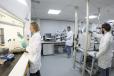
Publications by ANSTO's National Deuteration Facility.

The BRIGHT Nanoprobe beamline provides a unique facility capable of spectroscopic and full-field imaging. NANO will undertake high-resolution elemental mapping and ptychographic coherent diffraction imaging. Elemental mapping and XANES studies (after DCM upgrade) will be possible at sub-100 nm resolution, with structural features able to be studied down to 15 nm using ptychography.


The Advanced Diffraction and Scattering beamlines (ADS-1 and ADS-2) are two independently operating, experimentally flexible beamlines that will use high-energy X-ray diffraction and imaging to characterise the structures of new materials and minerals.
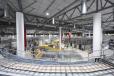
With enhanced submicron spatial resolution, speed and contrast, the Micro-Computed Tomography beamline opens a window on the micron-scale 3D structure of a wide range of samples relevant to many areas of science including life sciences, materials engineering, anthropology, palaeontology and geology. MCT will be able to undertake high-speed and high-throughput studies, as well as provide a range of phase-contrast imaging modalities.