

Showing 21 - 40 of 421 results
What's new in nuclear power technologies
It's ANSTO's role to keep Australia across the very latest developments in nuclear science and technology from around the world. Part of this responsibility is keeping us abreast of the latest developments in nuclear power technologies.
Leveraging over half a century of knowledge in the safe management of radioactive waste
ANSTO's Chief Nuclear Officer shares insights on the safe management of Australia's nuclear waste.
Sydney and Perth schools tackle playground waste and clean up with first prize in ANSTO's hackathon
Schools' participation high for National Science Week
Just under 250 schools in Australia and one school in Malaysia will participate in a series of science-based competitions during to coincide with National Science Week in 2024.
ANSTO's 'Sharpening the Focus' Summit Series Kicks Off with a Resounding Success
Certificate of appreciation from WA DFES
ANSTO and the Australian Radiation Protection and Nuclear Safety Agency (ARPANSA) have been recognised for their valuable contributions to the search and recovery efforts for a missing 8mm-long radioactive capsule in the Western Australian outback.

Update: Regional Cooperative Agreement (RCA) Cooperative Projects (Asia and Pacific)
ANSTO is coordinating and facilitating the calling of pre-concept papers for the next cycle of technical cooperative project proposals under the Regional Cooperative Agreement for Research, Development and Training Related to Nuclear Science and Technology for Asia and the Pacific (RCA) | IAEA
Exceptional group of women at the forefront of science outreach at ANSTO
Five exceptional female science communicators are part of a larger team who use skills in education and engagement to promote an interest in science amongst the public and students.

Privacy Policy
Australian Nuclear Science and Technology Organisation (ANSTO) is committed to protecting your personal information in accordance with the Privacy Act 1988 (Cth) (Privacy Act) and the Australian Privacy Principles.
Australian led cancer project making an impact at its first regional training course in Malaysia
The Australian led regional cancer care project in medical physics held its first regional training course in Malaysia to progress Rays of Hope.
Environmental Protection
ANSTO is committed to minimising the environmental impact of its activities and to implementing strategies which have a positive effect on the environment. The ANSTO Work Health Safety and Executive Committee oversees this process.
Powerful collaborations using ANSTO scientific infrastructure help to improve cancer outcomes
10th birthday of OPAL nuclear research reactor marks a decade of research
University appointment
Dr Anna Paradowska has been appointed as a Conjoint Professor of Practice in Advanced Structural Materials at the University of Sydney.
Graduate profile - Monica Hibberd & Hamish McDougall
Monica Hibberd and Hamish McDougall are working together on research into greener and more efficient energy and battery technology.
Australia completes first phase of its waste repatriation project
Independent Regulator Assessing ANSTO Infrastructure Plan
ANSTO-University of Wollongong Joint Project Seed Funding
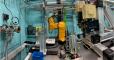
Micro-Computed Tomography beamline (MCT)
With enhanced submicron spatial resolution, speed and contrast, the Micro-Computed Tomography beamline opens a window on the micron-scale 3D structure of a wide range of samples relevant to many areas of science including life sciences, materials engineering, anthropology, palaeontology and geology. MCT will be able to undertake high-speed and high-throughput studies, as well as provide a range of phase-contrast imaging modalities.