

Showing 21 - 40 of 43 results
ANSTO scientists would have preferred more about the physics but impressed with Oppenheimer
In part 1 of this two-part series, ANSTO scientists from across the organisation became film critics to review Christopher Nolan’s new movie, Oppenheimer, which explores the life of the director of the Manhattan Project to develop an atomic weapon.
Australia leads progress in agriculture project in Asia and the Pacific
Australia is leading an agriculture project in the Asia and Pacific region, in partnership with the International Atomic Energy Agency (IAEA) and the Regional Cooperative Agreement for Research, Development and Training Related to Nuclear Science and Technology for Asia and the Pacific (RCA) to progress Atoms4Food.

Research Program Manager
Role at ANSTO
Outstanding individuals recognised in ANSTO Awards
Outstanding individuals and teams have been recognised for their outstanding work, innovation, excellence in the 2025 ANSTO Awards.
Innovative technology provides enhancement to advanced radiation therapy
Neutron Capture Enhanced Particle Therapy developed at ANSTO.
Innovation forum will benefit graduates and Australian industry
The first National Graduate Innovation Forum will be held in November to connect PhD students with representatives from four of Australia’s leading industries to apply scientific thinking to current real-world challenges.
Australian-first detector to accelerate cancer research
Multi-million dollar Australian Cancer Research Foundation (ACRF) Detector launched at the Australian Synchrotron,
ANSTO plastic trawling from Hobart to Sydney
Minister announces new detector
Australian-first detector to accelerate cancer research unveiled.

Leader, Nuclear Stewardship
Role at ANSTO
Crystallography out of this world
Symposium on advanced therapy
Science and medical experts meet in Adelaide to discuss great potential of particle therapy in Australia
Elusive class of compounds found
Neutron scattering has contributed to a 'tour de force' of chemistry led by Monash University.

Isotope Ecologist
Role at ANSTO
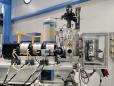
High-energy heavy ion microprobe
The high-energy heavy-ion microprobe is used for the characterisation or modification of material properties at depths from approximately 1 micrometre to maximum depths of up to 500 micrometres from the material surface.
Research supports potential local supply chain for component in COVID PCR test
University of Melbourne researchers have investigated a method to produce magnetic nanoparticles in Australia for use in COVID-19 PCR tests.
Using ocean water to understand feeding habits of Humpback Whales

Access to information
New underground lab to shed light on dark matter
Stage 1 of the Stawell Underground Physics Laboratory was officially opened today. It will be home to multi-disciplinary scientists from five research partners who help us understand dark matter.