

Showing 21 - 40 of 65 results
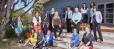
Connect with ANSTO's Women in STEM
Read about an ANSTO scientist and their work to prepare for a school project or interview.
UM2022 Speakers

Highlights - Cultural Heritage
Over the last decades, neutron, photon, and ion beams have been established as an innovative and attractive investigative approach to characterise cultural-heritage materials.
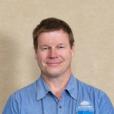
Technical Officer
Role at ANSTO
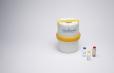
ANSTO's Gentech® Generator
Supporting healthcare professionals in Australia with easy-to-access resources related to ANSTO’s Gentech® Generator.
Capabilities
ANSTO provides access to specialised facilities and capabilities by application. Please ensure that you contact the relevant ANSTO scientist for advice before submitting a proposal.
Plans to safely manage medical and research waste
ANSTO will make an application to the independent nuclear regulator, ARPANSA, to vary its license for its Interim Waste Store. The original operating license was approved in 2015, enabling the facility to hold what is called a TN-81 cask of intermediate-level radioactive waste that was safely repatriated from France in 2015.
What are radioisotopes?
Radioisotopes are widely used in medicine, industry, and scientific research. New applications for radioisotopes are constantly being developed.
Imaging and medical
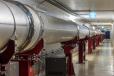
The Imaging and Medical beamline (IMBL) is a flagship beamline of the Australian Synchrotron built with considerable support from the NHMRC. It is one of only a few of its type, and delivers the world’s widest synchrotron x-ray ‘beam’.
$12.5 million for new jobs from ANSTO’s Innovation Precinct
The NSW Government will invest $12.5 million to support the expansion of the Innovation Precinct at the Lucas Heights campus of the Australian Nuclear Science and Technology Organisation (ANSTO).
Triggers of tree mortality revealed
Advanced imaging technique used to study triggers that lead to tree death
Call for Proposals
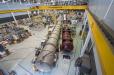
Proposals at the Australian Centre for Neutron Scattering and National Deuteration Facility.
Nuclear medicine congress
Congress marks watershed moment for nuclear medicine and ANSTO
New study reveals understanding of a basic physical property of charged particles in microgravity
International study has revealed a clustering of charged particles in the microgravity environment of space,with implications for the development of materials and better drugs that depend on the mixing of two or more charged particles.
Nuclear Medicine
ANSTO manufacture and supply a range of radiopharmaceuticals, radiochemicals, kits and accessories for use in research, industry and the health sector.
Gamma irradiation
ANSTO operates a range of cobalt-60 gamma irradiators, providing the Australian community with a range of irradiation services for medical, health, industry, agriculture and research purposes.
Feathery moa’s fossilised footprints, ancient age revealed
ANSTO scientist, Dr Klaus Wilcken of the Centre for Accelerator Science, used cosmogenic nuclide dating to determine the ages of layered sand and gravel samples, in which seven footprints of the flightless bird, the moa, were found on the South Island in New Zealand in 2019.
Leveraging over half a century of knowledge in the safe management of radioactive waste
ANSTO's Chief Nuclear Officer shares insights on the safe management of Australia's nuclear waste.
A possible world record: Studying thin films under extreme temperatures with reflectometry
A team of researchers from ANSTO and University of Technology Sydney have set a record by conducting thin film experiments at 1100 degrees C.