


Showing 301 - 320 of 1113 results

Highlights - Energy Materials
Highlights of the Energy Materials Project.

Corporate Publications
Explore ANSTO's range of publications and reports available for the public.

Green geopolymer concretes for Australian construction industry
There has been an increasing pressure on construction industrial sector to utilise innovative materials that not only meet the requirements of ambitious architectural designs, but also reduce CO2 emissions.
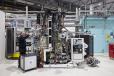
Soft x-ray spectroscopy
Soft x-rays are generally understood to be x-rays in the energy range 100-3,000 eV. They have insufficient energy to penetrate the beryllium window of a hard x-ray beamline but have energies higher than that of extreme ultraviolet light.

A robust mixed metal-organic framework for CO2 absorption and conversion

MABI Multi-wavelength absorption black carbon instrument
The Multi-wavelength absorption black carbon instrument MABI can determine the concentration and source of black carbon pollution.

Flexible, printable X-ray detectors
Low-cost X-ray detectors featuring high sensitivity, durability and physical flexibility are required in fields ranging from medical imaging to defence. In this study, a new material for X-ray detection was coupled with inkjet printing to produce a series of prototype X-ray detectors.
Ultra-sensitive accelerator technique traces the rise and fall of a giant Himalayan glacier
ANSTO has supported a new study published in Quaternary Science Reviews that dates the dramatic collapse of one of the largest glaciers ever documented in the Himalayas. The findings overturn a long-held assumption about what sustains wet-climate glaciers.

Think Science! Competition 2026
The Think Science! competition encourages students in Years 3-10 to learn science inquiry skills in a fun and accessible way! Entry is FREE and there are generous prizes for winning schools. Any topic can be chosen, and special materials are not required.

How to make a complaint about ANSTO

Science Highlights - IMBL
A selection of research highlights, instrument news and technical developments for scientists.

Science Inquiry Skills
The Think Science! event encourages students to engage with the Science Inquiry Skills process as outlined in the Australian National Curriculum.

Privacy Policy
Australian Nuclear Science and Technology Organisation (ANSTO) is committed to protecting your personal information in accordance with the Privacy Act 1988 (Cth) (Privacy Act) and the Australian Privacy Principles.
Celebrating Australian women in nuclear
Highlighting the contribution of four inspirational ANSTO leaders on International Women's Day.
ANSTO scientists share thoughts on Oppenheimer film

Animal Ethics Approval - Australian Synchrotron
Guidance for obtaining and maintaining human or animal ethics approval at the Australian Synchrotron.
The composition and manufacturing history of African swords revealed
ANSTO scientists were members of an inter-disciplinary team led by the University of Sydney, who examined six 19th century West African swords, using a non-invasive multi-methodological approach to reveal the composition and manufacturing history of the iron implements.
Improving the performance of cold sprayed additive manufactured Titanium

Environment
Unique landmark instrumentation and expertise are a hallmark of ANSTO’s sovereign capability, unavailable anywhere else in Australia. Our ability to identify the source of hazardous particulates in air, the age of water in aquifers and the detailed chemistry of toxic elements in complex soil and biota specimens are just some examples of ANSTO capability.