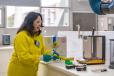
Sample Environments Group Leader


Showing 341 - 360 of 369 results

In accordance with the Trust Deed, the United Uranium Scholarship is awarded to ‘promising young scientists’ from any Australian organisation or institution whose research or work is in the field of nuclear energy.
The physics and chemistry used at ANSTO is built upon, in significant part, by pioneering female scientists who were sidelined, expelled, or simply not credited appropriately for their achievements.
ANSTO to ensure ultra-low radiation environment in newly-funded Stawell Underground Physics Laboratory.

This COVIDSafe Plan describes the actions that ANSTO will take to keep our staff, contractors and visitors safe and minimise the risk of the spread of COVID-19 infection.

Role at ANSTO



Radiation testing of electronic components at ANTO could benefit the aviation industry, regulators and most importantly, passengers as solar radiation events increase.

Andrew Peele was appointed Group Executive for ANSTO Nuclear Science and Technology in July 2021 and was Director of the Australian Synchrotron from 2013 -2021. He is an adjunct Professor of Physics at La Trobe University.
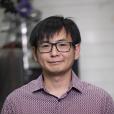
Role at ANSTO

The BRIGHT Nanoprobe beamline provides a unique facility capable of spectroscopic and full-field imaging. NANO will undertake high-resolution elemental mapping and ptychographic coherent diffraction imaging. Elemental mapping and XANES studies (after DCM upgrade) will be possible at sub-100 nm resolution, with structural features able to be studied down to 15 nm using ptychography.
A collaboration of scientists from RMIT, ANSTO and the CSIRO has published pioneering research that brings new insights into intrinsically disordered proteins and protein regions (IDPs)/ (IDRs) and how they behave under various physiological processes.
3D models of multilayered structures on engineering scale from nanoscale damage profiles.