

Showing 561 - 580 of 928 results
Research supports potential local supply chain for component in COVID PCR test
University of Melbourne researchers have investigated a method to produce magnetic nanoparticles in Australia for use in COVID-19 PCR tests.
Synchrotron techniques reveal amount of carbon captured in microscopic seams of deep-sea limestone
A collaboration of Australian scientists has used ANSTO’s Australian Synchrotron to measure the amount of carbon that is captured in microscopic seams of deep-sea limestone, which acts as a carbon sink.
Funding and infrastructure boost for Australian Synchrotron
$80.2 million in new funding to expand the research capabilities of the Australian Synchrotron.
Understanding corrosion in concrete sewer pipes
Using neutron imaging techniques at ANSTO, researchers from Macquarie University have gained a better understanding of how corrosion forms and spreads through concrete that is commonly used in sewer pipes.
Synchrotron reveals an elusive molecular chameleon
Research highlights published and Swiss delegation visits

Instrument Scientist
Dr Filomena Floriana Salvemini is an instrument scientist on the neutron imaging instrument DINGO.
Space research collaboration
ANSTO launches new area of space research in collaboration with the National Centre for Space Studies and the National Institute of Health and Medical research in France.

Samples - Infrared microspectroscopy
The Infrared microspectroscopy microscopes can record spectra from a range of different samples; from thin microtomed sections to polished blocks and embedded particles. This section highlights the types of samples that can be analysed using the IRM beamline
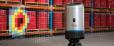
Features and benefits
Overlaying a 360° x 90° radiation image onto a panoramic optical image of the scene, makes interpretation much easier. The spectroscopic detector at the heart of the imager enables the accurate visualisation and identification of sources across a broad energy range.
Improving the radiation tolerance of microelectronics for space
A team of Melbourne researchers and international partners from Italian Instituto Nazionale de Fisica Nucleare (INFN) and CERN, who are developing radiation-hardened semiconductor chips, used the unique state-of-art high energy ion microprobe on the SIRIUS ion accelerator at ANSTO’s Centre for Accelerator Science to test a prototype radiation-resistant computer chip

Senior Instrument Scientist
Role at ANSTO

Research Leader, Atmospheric Research Group
Role at ANSTO
Instrument Scientist (The triple-axis spectrometers Sika and Taipan)
Role at ANSTO
Inaugural particle therapy study tour to Japan
Australian researchers and clinicians have recently returned from Japan where they investigated the use of advanced radiation therapy for cancer using heavy ions at particle therapy facilities on a study tour .
Tuning thermomechanical properties
Wombat used in study that showed tuneable thermal expansion by controlled gas sorption.
Distinguished researchers who use synchrotron techniques recognised
Nuclear techniques confirm rare finding that crocodile devoured a baby dinosaur

Research Program Manager