
Applications - Quokka
Applications on the Quokka instrument at ANSTO.


Showing 561 - 580 of 1508 results
Applications on the Quokka instrument at ANSTO.
Professor Vanessa Peterson, Senior Principal Research and Neutron Scattering Instrument Scientist and Leader of the Energy Materials Research project, has been awarded the Bob Cheary Award or Excellence in Diffraction Analysis by the Australian X-ray Analytical Association. She is the first female to be chosen for the award.
Research on the mechanism of cell death has insights to bring progress on neurodegenerative diseases and plant biosecurity.
Energy researchers from UNSW have reported progress using controlled architectural design and structural engineering as a method to fine-tune materials to have simultaneous high power and high energy density for the electrochemical storage in portable devices.

Combining X-ray techniques brings insights
With a well-established portfolio of nuclear research and the operation of Australia's only nuclear reactor OPAL, ANSTO scientists conduct both fundamental and applied research on fuel for current, advanced, and future nuclear technology systems.
ANSTO’s OPAL multi-purpose research reactor at Lucas Heights has officially returned to power and recommenced operations, following a months-long planned shutdown to carry out essential maintenance and upgrades.
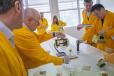
Students investigate the production of nuclear medicines in the OPAL multipurpose reactor, the use of nuclear medicines to diagnose and treat disease, and the science behind working safely with radiation.
This program is designed to address content and skill outcomes in the Year 9 and Year 10 Science Australian Curriculum and NSW syllabuses.
Cost: $90 per class.

In Australia and the Southeast Asia basin, the ANSTO facility offers a wide range of unique nuclear-beam techniques for cultural heritage research.
Clarity Pharmaceuticals is building on comprehensive work on chelators carried out at ANSTO.
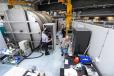
The Platypus instrument can be used to study all-manner of surface-science and interface problems, particularly related to magnetic recording materials and for polymer coatings, biosensors and artificial biological membranes.
A cross-disciplinary team has used laboratory-based and synchrotron-based infrared spectroscopy imaging techniques to monitor the waxy surface of living plant leaves in real-time to gain insights into plant physiology in response to disease, biological changes or environmental stress.
A study has provided insight into copper sulfate pentahydrate and could give clues to how other hydrated minerals change under the pressures within planetary environments