Webinar: Impacts of Decommissioning Oil & Gas Infrastructure
Connect with the businesses and organisations seeking better understanding decommissioning oil and gas infrastructure and the potential impact of contaminants on marine life.


Showing 761 - 780 of 1658 results
Connect with the businesses and organisations seeking better understanding decommissioning oil and gas infrastructure and the potential impact of contaminants on marine life.
Emu instrument Scientist Gail Iles has left the Australian Centre for Neutron Scattering for RMIT.
ANSTO environmental scientists have alerted the scientific community of the critical need to monitor changes to ice containing potential nuclear fallout that reached Antarctica from 20th century atmospheric weapons testing.

Links to all previous news and case studies published by the National Deuteration Facility
Professor Vanessa Peterson, Senior Principal Research and Neutron Scattering Instrument Scientist and Leader of the Energy Materials Research project, has been awarded the Bob Cheary Award or Excellence in Diffraction Analysis by the Australian X-ray Analytical Association. She is the first female to be chosen for the award.
A large group of ANSTO environmental scientists and collaborators have produced the first groundwater stable isotopes, ‘isoscapes’, intuitive maps with grid data, across NSW combining new and pre-existing isotope measurements.
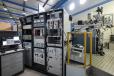
The Centre for Accelerator Science operates four ion accelerators with 11 on sources and 13 beamlines
Scientists from Monash, ANSTo and China have developed an ultra-thin membrane that could separate harmful ions from water or capture gases.
Potential new treatments and tools for depression under development.
Given the importance of water in Australia, surprisingly, there is relatively little information about the past variability of rainfall on this continent. Although there is a good annual record of the past 100 years in Australia, there is nothing much before that period and no known cave deposit records exist for New South Wales.

ANSTO's OPAL reactor is one of the world's most advanced and reliable research reactors today. To ensure we can continue operating OPAL safely and reliably and maximise utilisation, ANSTO must regularly carry out maintenance and upgrades.
Insights into the crystallisation process of twin crystals important for drug production.

ANSTO hosted an online training workshop for the FNCA (Forum for Nuclear Cooperation in Asia) project Combating Food Fraud using Nuclear Technology (CFF) in early December.