

Showing 81 - 100 of 120 results
Independent Report - Safety of Building 23
ANSTO has released the Independent Safety Review of Building 23 - Nuclear medicine production facility.
Fact or Fiction 2.0 comes to Ballarat
The risks posed by stormwater runoff can be monitored with thin-film technology
A large collaboration of Australian and New Zealand researchers has established that a thin film technology can be used to monitor stormwater effectively and provides a way to translate the presence of metal contaminants into potential risks to aquatic ecosystems.
End of an era for Australia’s first nuclear reactor
Beamtime Guide - XFM
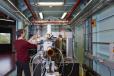
Beamtime Guide on the X-ray Fluorescence Microscopy beamline at the Australian Synchrotron.

Visit the Australian Synchrotron
ANSTO's Melbourne location is home to the ANSTO-owned and operated Australian Synchrotron. The Synchrotron is one of the Australia's most significant pieces of scientific infrastructure.
High-energy Heavy Ion Microbeam
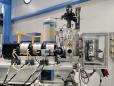
The high-energy heavy-ion microprobe is used for the characterisation or modification of material properties at depths from approximately 1 micrometre to maximum depths of up to 500 micrometres from the material surface.
Research highlights how to make food different and better by design
International researchers have used nuclear techniques at ANSTO - a centre for food materials science - to develop a methodology that could assist in the design of oleogel systems for food applications.
Feathery moa’s fossilised footprints, ancient age revealed
ANSTO scientist, Dr Klaus Wilcken of the Centre for Accelerator Science, used cosmogenic nuclide dating to determine the ages of layered sand and gravel samples, in which seven footprints of the flightless bird, the moa, were found on the South Island in New Zealand in 2019.
Independent report into safety of Building 23 at ANSTO
The final report on the safety of Building 23 by the independent expert review team has been completed.
'Atom hunters' broadcast on ABC
Using the past to illuminate the future: Brothers collaborate on important science documentary for ABC TV
Studying Western Australian caves to help us understand climate change
On average, there is now 17 per cent less rainfall across Western Australia’s south-western region than was recorded prior to 1970. This rainfall reduction has economic, social and environmental implications for the region, in particular for the growing capital of Perth, as well as water-dependent industries in the state.
ANSTO to help supply the world with nuclear medicine
Research captures dynamic atomic interactions in a promising sodium ion battery material
Investigators from UNSW and ANSTO have provided insights into the dynamic interactions of atoms in a promising material for sodium-ion batteries.
New global, first-of-a-kind ANSTO Synroc facility
A new nuclear medicine waste processing facility that showcases ANSTO Synroc technology is under construction.
Principal Research Scientist, Project Leader
Role at ANSTO
Research supports potential local supply chain for component in COVID PCR test
University of Melbourne researchers have investigated a method to produce magnetic nanoparticles in Australia for use in COVID-19 PCR tests.
Leveraging over half a century of knowledge in the safe management of radioactive waste
ANSTO's Chief Nuclear Officer shares insights on the safe management of Australia's nuclear waste.