What one moon flyby can and cannot do, and what comes next (Part 2)
Dr Mitra Safavi Naeini continues her commentary of the radiation studies being undertaken in the Artemis II mission.


Showing 121 - 140 of 332 results
Dr Mitra Safavi Naeini continues her commentary of the radiation studies being undertaken in the Artemis II mission.

Young physicist in training to become a surrogate inspector for Comprehensive Nuclear Test Ban Treaty Organisation.
There have been significant developments in small modular reactor technologies in 2022. The International Atomic Energy Agency expects small modular reactors (SMRs) to make an important contribution to achieving global climate goals and energy supply security. But with more than 70 SMR designs under development in 18 countries – including innovative reactors that are yet to be licensed and novel methods of modular manufacturing that are new to the nuclear industry – widely deploying SMRs in time remains a tall task.
Collaboration across the Tasman has enabled Australian and New Zealand researchers and scientists to shed light on a protein involved in diseases such as Parkinson’s disease, gastric cancer and melanoma.
ANSTO has produced a comprehensive report for the NSW Department of Planning and Environment that represents a significant scientific investigation of the connections, pathways and processes of water loss from the Thirlmere Lakes system.

The new facility will be built around a product line of ANSTO’s design – a new Technetium-99m generator – that will enable greater process automation than is possible with existing technology, leading to improvements in efficiency, quality and importantly the highest levels of production safety.

A world-class national research facility that uses accelerator technology to produce a powerful source of light-X rays and infrared radiation a million times brighter than the sun.
A collaboration of Australian scientists has used ANSTO’s Australian Synchrotron to measure the amount of carbon that is captured in microscopic seams of deep-sea limestone, which acts as a carbon sink.
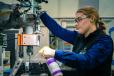
Ready to start a hands-on career? ANSTO’s Apprenticeship Program gives you the chance to earn while you learn, build real trade skills and contribute to work that supports Australia’s leading nuclear science and technology organisation.

Explore ANSTO's range of publications and reports available for the public.
ANSTO recently hosted a public Ask Us Anything event on nuclear medicine, sharing information on how we safely manufacture and distribute nuclear medicine across Australia each week to hundreds of hospitals and clinics.

The BRIGHT Project will expand the beamline infrastructure of the Australian Synchrotron to increase both its capacity and capabilities.
Study explored how key proteins manage dietary cholesterol absorption and elucidated crucial transport mechanisms that contribute to cholesterol balance in the body.

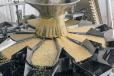
Understanding the molecular structure of ingredients can improve the qualities of food.
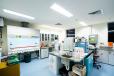
All safety requirements must be met while working at the Australian Centre for Neutron Scattering. Failure to do so may result in the suspension of experiments.