

Showing 1221 - 1240 of 2202 results
Carbon ion therapy research
ANSTO research focuses on an advanced form of cancer treatment under consideration in Australia.
Evaluating diets of farmed Pacific Oysters
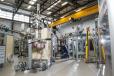
Particle Induced X-ray Emission
Particle Induced X-ray Emission (PIXE) is a powerful and relatively simple analytical technique that can be used to identify and quantify trace elements typically ranging from aluminium to to uranium.
The women of nuclear stewardship science are experts in the safe use of radioactivity
Reconstructing the history of the Australian landscape
Million year lag time in transport of sediment in Murray Darling River Basin system.
Australia joins international nuclear research forum
Not good-bye, but au revoir
Emu instrument Scientist Gail Iles has left the Australian Centre for Neutron Scattering for RMIT.
Gathering international experts to expand the impact of PET imaging
ANSTO expert in molecular imaging contributed to international workshop.
Gamma radiation imaging technology
A new imaging technology developed at ANSTO makes it possible to image, identify and locate gamma-ray radiation in a safe and timely manner.
Innovation Precinct highlighted in South District Plan
ANSTO’s Innovation Precinct has been highlighted in the Greater Sydney Commission’s South District Plan.
Non-invasive three-dimensional reconstruction of ancient opalised pearls reveals structure
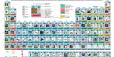
Year 7-8 Atoms, Elements and the Periodic Table Tour
Designed to address the new 2026 NSW Science Stage 4 (Year 7-8) syllabus, this tour is a hands-on introduction to atomic structure, the properties and classification of some elements, and the structure of the periodic table.
All tours are available Monday to Friday for Years 7 to 12 classes. The cost per student is $12.50 and teachers are free.
Please print enough copies of the relevant workbook for your class before your visit to ANSTO.
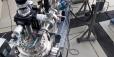
Year 12 Physics Tour
Our Year 12 Physics tour and depth study guide can be used as the starting point for a depth study about nuclear science, covering nuclear-related components of Module 8: From the Universe to the Atom.
All tours are available Monday to Friday for Years 7 to 12 classes. The cost per student is $12.50 and teachers are free.
Please print enough copies of the relevant workbook for your class before your visit to ANSTO.

Year 11 Chemistry Tour
Our Year 11 Chemistry tour and depth study guide can be used as the starting point for a depth study about nuclear science, covering nuclear-related components of Module 1: Properties of Structure and Matter.
All tours are available Monday to Friday for Years 7 to 12 classes. The cost per student is $12.50 and teachers are free.
Please print enough copies of the relevant workbook for your class before your visit to ANSTO.
Nuclear remote online Laboratory (FarLabs)
Freely Accessible Remote Laboratories (FarLabs) have developed a nuclear remote online laboratory that schools can use to perform experiments with nuclear radiation. Two experiments allow students to investigate the penetrating power of different forms of radiation and how the amount of radiation decreases with distance.
The FarLabs project is led by the Department of Physics at La Trobe University in collaboration with James Cook University, Curtin University, Quantum Victoria, V3 Alliance, and ANSTO.
First radioactive samples on our magnetometer
Fine particle pollution peaks during bushfires
Recent catastrophic Australian bushfires produced extremely high levels of fine particle pollution.
Australia’s OPAL multi-purpose reactor prepares for new milestone
Routine transport of spent nuclear fuel
Radiation School held
First Asia Oceania Forum held at the Australian Synchrotron