Book a school tour
Book a date with the Discovery Centre for your class.


Showing 1241 - 1260 of 1343 results
Book a date with the Discovery Centre for your class.

ANSTOs capabilities are ideally suited for these investigations relating to quantum technologies.
Energy researchers from UNSW have reported progress using controlled architectural design and structural engineering as a method to fine-tune materials to have simultaneous high power and high energy density for the electrochemical storage in portable devices.

In accordance with the Trust Deed, the United Uranium Scholarship is awarded to ‘promising young scientists’ from any Australian organisation or institution whose research or work is in the field of nuclear energy.
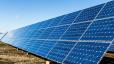
The design and implementation of alternative energy sources is one of the greatest scientific and social challenges of our time.
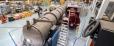
ANSTO’s Lucas Heights campus has an extensive range of specialised facilities and capabilities that are available to assist industry-based professionals in solving problems. Please contact us to discuss how we can assist you. We are open to entering into commercial arrangement with appropriate partners.

ANSTO has a variety of games and apps to educate students on how radiation works, nuclear medicine, the periodic table, and atom building.

The BRIGHT Project will expand the beamline infrastructure of the Australian Synchrotron to increase both its capacity and capabilities.
The role of trace elements as palaeoclimate proxies has been explored in ANSTO-led collaborative environmental research.
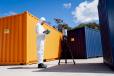
It is critical across many industries to identify and locate sources of radiation accurately and quickly. One of the more challenging aspects of dealing with radiation is that you cannot see it directly, which can result in potential exposure when working in those environments.
Research on the mechanism of cell death has insights to bring progress on neurodegenerative diseases and plant biosecurity.
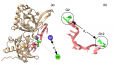
The Scientific Computing team supports researchers by performing numerical simulations that complement experimental research. In particular, we use state-of-the-art software to perform computational quantum mechanical modelling, molecular dynamics simulations, lattice dynamics calculation, data analysis and visualisations.
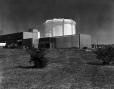
In April 15, 1953, Australia entered the nuclear science arena, when the Atomic Energy Act came into effect. The Australian Atomic Energy Commission (AAEC) followed and in 1987 the AAEC evolved into the Australian Nuclear Science and Technology Organisation (ANSTO) as it’s known today.
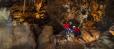
Research is being undertaken through an Australian Research Council Discovery Project "Reconstructing Australia’s fire history from cave stalagmites", led by Professor Andy Baker at UNSW Sydney and Dr. Pauline Treble at ANSTO. The project aims to calibrate the fire-speleothem relationship and develop coupled fire and climate records for the last millennium in southwest Australia.
A group from Monash university has sought to make a new innovative nano-porous sieve material which has the potential to be produced on a global scale and is effective for a much longer time.

Our people, the custodians of Australia’s nuclear and accelerator expertise, are amongst our nation’s most talented researchers, scientists, engineers and nuclear experts. Everyday we work to respond to the growing nuclear science and technology needs of Australia and the world.
Our world is rapidly transitioning to renewable energy and electric transport systems that require the safe and efficient mining of various metals.

ANSTO's Melbourne location is home to the ANSTO-owned and operated Australian Synchrotron. The Synchrotron is one of the Australia's most significant pieces of scientific infrastructure.
An accomplished international photographer has capture dazzling new images of one component of the main ring at our Australian Synchrotron and provided an inside view of the electron’s path when it is used.