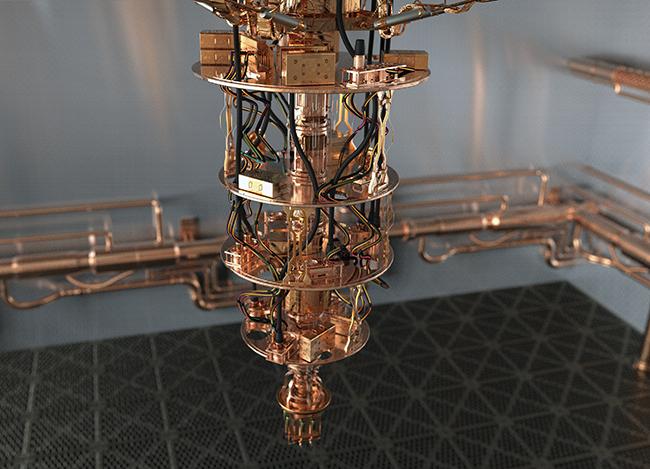
The development of quantum computers is a research priority for Australia and has been identified as an Australian Critical Technology.
A quantum computer makes use of the quantum states of subatomic particles to store information. Subatomic particles are made up of matter or energy and are smaller than an individual atom – several subatomic particles are found inside an atom.
ANSTO specialises in research at the scale of the atom, so we are well-placed to support Australia’s development of this new technology.
Quantum computers are more powerful than traditional computers because they use the quantum properties found in some materials, that are very different to the properties of conventional materials, such as the silicon in processor chips.
Two quantum effects are the building blocks of qubits.
Superposition (a system existing in several separate quantum states at the same time) or entanglement (when the quantum properties of particles are inextricably linked) greatly enhance data storage and computational power.
These quantum properties can only be detected at the atomic level. Like a tennis ball stopped by a net, conventional methods cannot penetrate an atom. However, sub-atomic particles are small enough to detect and interact with an atom’s nucleus or electrons.
ANSTOs capabilities are ideally suited for these investigations.
Researchers have access to high energy, intensive X-rays at the Australian Synchrotron and neutrons at the Australian Centre for Neutron Scattering to investigate and characterise the properties of quantum materials.
Techniques at the Centre for Accelerator Science can be used to fabricate engineered devices for novel functions in advanced sensing and computing with precision ion implantation, such as for quantum photonic sensors.
These methods probe such exotic states as quantum spin states, quantum tunnelling and topological insulation.