Using nuclear techniques for coastal environments
IAEA Regional Training Course on coastal environments held at ANSTO for representatives from Asian Pacific.


Showing 1241 - 1260 of 2202 results
IAEA Regional Training Course on coastal environments held at ANSTO for representatives from Asian Pacific.

How can you speed up your production pathway to better surface modification?
ANSTO’s Innovation Precinct has been identified as an “emerging precinct” in the Federal Government’s Statement of Principles for Australian Innovation Precincts.

Our Year 12 Investigating Science tour and depth study guide can be used as the starting point for a depth study about nuclear science, covering nuclear-related components of Module 6: Technologies and Module 8: Science and Society.
All tours are available Monday to Friday for Years 7 to 12 classes. The cost per student is $12.50 and teachers are free.
Please print enough copies of the relevant workbook for your class before your visit to ANSTO.
ANSTO is coordinating and facilitating a new cycle of Australian project proposals for the Regional Cooperative Agreement (RCA).
Researchers developing new materials and devices that can withstand the harsh radiation environment in space are using the unique ANSTO’s capability to simulate the effects of high-energy ion irradiation on the properties and performance of these materials and devices.
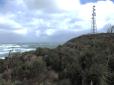
Measurements of the naturally-occurring radioactive gas radon can be used to accurately categorise the degree of atmospheric mixing.
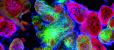
The measurement and manipulation of radiation and radioactive materials within biological systems. Capabilities include access to a range of radioisotopes, gamma/X-ray sources and a selection of X-ray beams, ion beams and neutron beams for irradiation.

Your students can analyse real research data from ANSTO scientists.
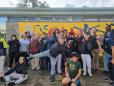
The Deaf Youth Science Camp is a chance for Deaf/hard-of-hearing young people (aged 12-17 years old) to participate in an immersive science experience.
At the camp, participants will do hands-on science activities, go on tours of different science facilities, and meet Deaf STEM professionals. The camp is also an opportunity to develop personal and leadership skills as well as enhance friendship networks.
This camp is hosted by Deaf Youth Australia and ANSTO. In 2025, the camp was funded by a National Science Week grant.
Using geoarchaeology to reconstruct the history of an ancient Khmer city.
Unique opportunity to contribute to the long term conservation of Australia’s most iconic landmark: The Sydney Harbour Bridge.
ANSTO Nuclear Fuel Cycle researcher recognised for contributions to crystallography and structural chemistry on actinides and lanthanides.
Just under 250 schools in Australia and one school in Malaysia will participate in a series of science-based competitions during to coincide with National Science Week in 2024.