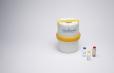
Producing fish oil without odour and a longer shelf life
Research undertaken by Flinders University, the University of Cincinnati (US), Guangzhou University (China) and ANSTO has evaluated a new process to encapsulate fish oil in nanoparticles
Showing 161 - 180 of 397 results
Research undertaken by Flinders University, the University of Cincinnati (US), Guangzhou University (China) and ANSTO has evaluated a new process to encapsulate fish oil in nanoparticles
Supporting healthcare professionals in Australia with easy-to-access resources related to ANSTO’s Gentech® Generator.
Jack the Super Prawn lives in the Barrier Reef and uses his powers to protect the environment. With JackVac, he cleans up rubbish and impurities in seawater. With JackCopter, he soars high into the air, where you wouldn't normally see a prawn.
Nick is a radiation biologist who works for the NST Human Health research theme.
ANSTO is one of the world's leading providers of irradiation services for silicon ingots, which are used by the multimillion dollar electronics industry across Europe and Asia. Each year, ANSTO irradiates more than 50 tonnes of silicon.
A group from Monash university has sought to make a new innovative nano-porous sieve material which has the potential to be produced on a global scale and is effective for a much longer time.
ANSTO's OPAL reactor is one of the world's most advanced and reliable research reactors today. To ensure we can continue operating OPAL safely and reliably and maximise utilisation, ANSTO must regularly carry out maintenance and upgrades.
Voucher scheme accelerating medical research
Research will change understanding of Australian Aboriginal rock art found in rock shelters of the Kimberley and its relationship to a changing landscape
An initiative for National Science Week 2024 the Shorebirds Competition addresses the 2024 theme for National Science Week, ‘Species Survival’ and provides unique cross-curricula learning for Australian primary students in Years 3 to 6.
The below report has been prepared in accordance with the requirements of the Australian Nuclear Science and Technology Organisation Act 1987 (ANSTO Act) and section 46 of the Public Governance, Performance and Accountability Act 2013 (PGPA Act).
The Advanced Diffraction and Scattering beamlines (ADS-1 and ADS-2) are two independently operating, experimentally flexible beamlines that will use high-energy X-ray diffraction and imaging to characterise the structures of new materials and minerals.
The instrument is very well suited for the study of kinetic effects, like relaxation following a chemical reaction, or external impulses like mechanical deformation, an electric or magnetic field.
Are you a school student who likes a creative challenge? Enter our new Incredible Insects Competition during the month of July 2021! You could win yourself a prize pack worth over $100! School students from all States/ Territories of Australia are invited to enter.