
Koala - Laue Diffractometer
Koala is one of the leading small-molecule crystallography instruments in the world for determining the complex crystal structure of a wide range of chemicals and minerals.


Showing 21 - 40 of 72 results
Koala is one of the leading small-molecule crystallography instruments in the world for determining the complex crystal structure of a wide range of chemicals and minerals.
ANSTO is taking its innovative ANSTO Synroc® and CORIS360® technologies to the world stage at the Waste Management Symposia 2024 in Phoenix, Arizona USA this week (10 – 14 March 2024). Joining over 45 other countries and around 3,000 attendees, an Australian Government contingent comprising of ANSTO and the Australian Radioactive Waste Agency is in attendance to showcase Australia’s extensive radioactive waste management capabilities.
Thales Australia, a key supplier to the Australian Defence Forces, provided an industrial challenge to National Graduate Innovation Forum participants relating to the production of piezoelectric ceramic components used in naval sonar arrays and systems.

The project aims to engage the wider cultural heritage community in addition to our internal research.
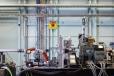
Samples on the X-ray fluorescence microscopy beamline at the Australian Synchrotron.
Using isotopes to understand saltwater intrusion of Rottnest Island groundwater
Researchers and industry partners from UNSW Australia, the Australian Centre for Nanomedicine, Children’s Cancer Institute and Inventia Life Sciences Pty Ltd have been awarded the 2021 ANSTO Eureka Prize for Innovative Use of Technology for their method to rapidly-produce 3D cell structures

ANSTO has been tracking and publishing data on fine particle pollution from key sites around Australia, and internationally, for more than 20 years.

An international team of academic researchers led by Curtin University have provided a description of a new species of pterosaur, a flying reptile.
The need for a smaller, more transportable version of ANSTO’s 1500-litre atmospheric radon-222 monitor, and with a calibration traceable to the International System of Units, prompted the team to develop a 200-litre radon monitor that would meet those needs.
Atomic structure of new cathode material for sodium ion batteries helps explain long life
Favourable conceptual design review may lead to expanded role for Australia on ITER diagnostics.
International interest is building in Australia’s new multi-million-dollar radioactive waste processing facility at the Sydney campus of the Australian Nuclear Science and Technology Organisation (ANSTO).
The analytical power of non-destructive X-ray fluorescence microscopy (XFM) at the Australian Synchrotron has been highlighted in a book chapter in Giorgione, Dante and the Sydney Incunable that features its use on an historic Renaissance work, Dante’s Commedia.
The mechanical, electrical, chemical, optical and thermal properties of glass, as determined by its chemical composition and atomic structure, make it a highly useful material with a myriad of applications.
A study has provided insight into copper sulfate pentahydrate and could give clues to how other hydrated minerals change under the pressures within planetary environments