Sharing expertise with Japan
The National Deuteration facility is assisting with the establishment of a Japanese Chemical Deuteration Facility.


Showing 441 - 460 of 673 results
The National Deuteration facility is assisting with the establishment of a Japanese Chemical Deuteration Facility.
The instrument is very well suited for the study of kinetic effects, like relaxation following a chemical reaction, or external impulses like mechanical deformation, an electric or magnetic field.
The Australian Academy of Technology and Engineering (ATSE) has elected Professor Andrew Peele, Director of ANSTO’s Australian Synchrotron, to become a Fellow of the prestigious organisation.
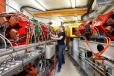
The Accelerator Science group purse a broad research program with the aims of improving the performance and reliability of our accelerators, increasing their research capabilities and developing the next generation of accelerator technology.
A world-first processing technology developed in collaboration by ANSTO’s Minerals unit.
Monash University researchers have used advanced techniques at ANSTO to investigate the production of new, elongated polymer nanocapsules with a high payload of drug nanocrystals to potentially increase drug targetability, and also decrease dosage frequency and side effects.


Aboriginal leaders and advocates have joined together today to call out commercial companies exploiting native food knowledge without adequate community engagement.

Radioisotopes are widely used in medicine, industry, and scientific research. New applications for radioisotopes are constantly being developed.
Excellent radiolabelling facilities and the operation of OPAL, a world-class multi-purpose nuclear reactor, enable ANSTO to produce a large range of radioisotopes for Australian researchers in both radiopharmaceutical and environmental areas.
ANSTO has installed a radon detector for Curtin University in Burrup WA as part of the Murujuga Rock Art Monitoring Program
Environmental Scientist Amy Macintosh is researching the impact of the petroleum industry on Australian marine life.
Groundwater experts from ANSTO and UNSW have led a collaboration of Australian and American researchers to analyse the composition of deep, very old groundwater and develop a new conceptual framework that describes the degradation of carbon over time in the subsurface.
A groundbreaking international study has provided new insights into global fossil methane emissions, using innovative multi-isotopic atmospheric measurements.
An accomplished international photographer has capture dazzling new images of one component of the main ring at our Australian Synchrotron and provided an inside view of the electron’s path when it is used.