

Showing 81 - 100 of 113 results
New partnership
Australia and Sri Lanks signs new partnership to fight chronic kidney disease.

Nuclear Chemist
Role at ANSTO

Anonymised Review
ANSTO has agreed to participate in an Australian trial of a review of research infrastructure access proposals in which applicants remain anonymous to aid the removal of structural barriers to the career progression of Women in STEM.

Analytical Experimental Officer
Role at ANSTO

User Meeting 2020 Invited Speakers
The User Advisory Committee (UAC) are pleased to present this year's invited speakers.
Using cosmic ray 'clocks in rocks' to understand climate change

Food and health
Consumers want to know that the foods they consume provide health benefits. Food materials science can monitor changes during digestion as well as assist in the development of low-fat products.

Melbourne Access Proposals
ANSTO’s user office in Melbourne offers access to the Australian Synchrotron, a world-class research facility with over 4,000 user visits per year. ANSTO seeks collaboration and partnerships with research organisations, scientific users and commercial users.

What are radioisotopes?
Radioisotopes are widely used in medicine, industry, and scientific research. New applications for radioisotopes are constantly being developed.

Samples - Infrared microspectroscopy
The Infrared microspectroscopy microscopes can record spectra from a range of different samples; from thin microtomed sections to polished blocks and embedded particles. This section highlights the types of samples that can be analysed using the IRM beamline
Big Ideas
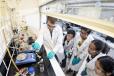
ANSTO Big Ideas encourages students to creatively communicate the work of an Australian scientist, and explain how their work has inspired them to come up with a Big Idea to make our world a better place. This competition is intended to engage and support Australian students in years 7-10 in Science and encourage them to pursue studies and careers in STEM.

Senior Principal Research and Neutron Scattering Instrument Scientist
Role at ANSTO
- Leader, Energy Materials Research Project
The best behind the neutron beam: Awards announced
Four annual awards in neutron scattering were announced at Australian Neutron Beam Users Group (ANBUG) and AINSE Neutron Scattering Symposium (AANSS) to individuals with strong links to ANSTO

Postdoctoral Research Fellow
Role at ANSTO
Principal Research Scientist, Project Leader
Role at ANSTO
Neutron Reflectometry Instrument Scientist
Role at ANSTO

ASP databases
Datasets from the Aerosol Sampling Program.

Beamtime guide - Imaging and Medical
Information has been provided to assist with the preparation of experiment proposals and beamtime.

Archive
See details of previously published customer updates from our Health products team.