
Collaborators - Planetary Materials
We are part of the Planetary Science community in Australia


Showing 1021 - 1040 of 1658 results
We are part of the Planetary Science community in Australia
Let your students lead a 30-minute Q&A session with our ANSTO experts about one of the following three topics:
- Nuclear medicines
- Nuclear techniques to study the environment
- Fission and its applications in reactors
Please ensure your students do some pre-reading about the research topic and come prepared with questions to ask during the session. We also ask that teachers send us a copy of the student questions the day before, so we can adequately prepare for your session. Teachers must be present during the session with their students.
Cost: Free
Moving earth in the search for dark matter: laboratory construction underway at mine site.
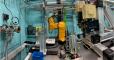
With enhanced submicron spatial resolution, speed and contrast, the Micro-Computed Tomography beamline opens a window on the micron-scale 3D structure of a wide range of samples relevant to many areas of science including life sciences, materials engineering, anthropology, palaeontology and geology. MCT will be able to undertake high-speed and high-throughput studies, as well as provide a range of phase-contrast imaging modalities.

Technical information on instruments, facilities, and access for users. The Centre is one of three research infrastructure facilities at ANSTO supported by NCRIS.

At ANSTO we have a large range of facilities that can be used to investigate planetary materials.
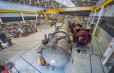
Scientists and researchers within ANSTO's Australian Centre for Neutron Scattering area have been published in a wide range of publications and have presented at many conferences.
ANSTO team earns top paper award from American Ceramic Society
Researchers from the University of New South Wales have developed a new type of rechargeable battery that uses protons as charge carriers, offering a safer and more environmentally friendly alternative to conventional lithium-ion batteries.
A cross-disciplinary team has used laboratory-based and synchrotron-based infrared spectroscopy imaging techniques to monitor the waxy surface of living plant leaves in real-time to gain insights into plant physiology in response to disease, biological changes or environmental stress.
Retrieving an Antarctic ice core more than a million years old presents challenges and opportunities.
ITRAX has now analysed more than a kilometre of cores since it became operational in 2012.
ANSTO’s CORIS360®, an advanced radiation imaging solution, has been awarded two Gold Good Design Awards from Good Design Australia, winning in the categories of Product Design/ Commercial and Industrial as well as Engineering Design.
In cooperation with ANSTO and for the third year running, the IAEA has recently hosted a two-week online training course for women professionals working in numerous nuclear industries around the world, titled 'Women 4 Nuclear Science in Education and Communications'.
Research explores how structure contributes to function in food
The National Deuteration Facility has supplied deuterium labelled lipids to quantify lipid biomarkers in a blood test to help diagnose breast cancer.