Award recipients to present Distinguished Lectures
Award recipients Dr Richard Garrett and Dr Nigel Lengkeek with Dr Tien Pham will deliver a Distinguished Lecture on 15 November at ANSTO.


Showing 121 - 140 of 212 results
Award recipients Dr Richard Garrett and Dr Nigel Lengkeek with Dr Tien Pham will deliver a Distinguished Lecture on 15 November at ANSTO.
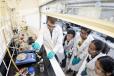
ANSTO Big Ideas encourages students to creatively communicate the work of an Australian scientist, and explain how their work has inspired them to come up with a Big Idea to make our world a better place. This competition is intended to engage and support Australian students in years 7-10 in Science and encourage them to pursue studies and careers in STEM.

On the 10th of October 2025, the Minister for Industry, Science and Technology provided his Statement of Expectations to ANSTO.
ANSTO hosted an international meeting of Expert and Policy group members for Generation IV Forum (GIF).
Imaging protocol assesses molecular mechanism of work in the treatment of deadly childhood cancer neuroblastoma.

The new Micro Computed Tomography (MCT) beamline is the first instrument to become operational as part of the $94 million Project BRIGHT program, which will see the completion of eight new beamlines at ANSTO’s Australian Synchrotron.
This joint initiative at ANSTO has developed a new capability: solid surface radiolabelling to evaluate Auger emitting sources for next-generation targeted therapy.
ANSTO is working with government partners to ensure that radioactivity in drinking water supplied to Aboriginal communities is at levels considered safe for consumption.
International neutron scattering award for retired head of former Bragg Institute, Prof Robert Robinson

Innovative medical device Rhenium-SCT® therapy for non-melanoma skin cancer is now available in Australia
Research led by a group from the University of Newcastle has found a new way to make silcone surfaces – and have even discovered that they can control how slippery they are.
Thirty years of ANSTO's unique capability in monitoring fine particle pollution provides insight on bushfire smoke.