ANSTO inspires young women into STEM careers
To celebrate International Women’s Day, ANSTO opened its doors to more than 50 female STEM students who heard from two accomplished ANSTO’s female scientists and STEM champions.


Showing 1261 - 1280 of 1705 results
To celebrate International Women’s Day, ANSTO opened its doors to more than 50 female STEM students who heard from two accomplished ANSTO’s female scientists and STEM champions.
A new radiocarbon dating facility opened at the University of New South Wales (UNSW) will complement the extensive radiocarbon facilities at ANSTO’s world-leading Centre for Accelerator Science
Historic memorandums of understanding on the peaceful use of nuclear with Thailand and Canada.
ANSTO's unique capabilities are being used to develop a quick analytical tool to determine the geographic origin of seafood and authenticates quality.

The project aims to engage the wider cultural heritage community in addition to our internal research.
Nuclear science and technology award recipients to deliver Distinguished Lectures at ANSTO.
ANSTO radiocarbon facilities and scientists are featured in a new IMAX documentary film released in the United States.
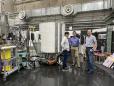
The instrument is ideally suited to study of spin and lattice dynamics, magnon and phonon dispersion relations in single crystal samples.
Radioisotope tracing technique are used to understand the uptake of contaminants, and nutrients, bioaccumulation, by aquatic organisms and terrestrial plants.
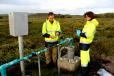
Water is a resource that needs careful management to ensure it is used sustainably. In this data set, students analyse real research data about the sustainability of groundwater on Rottnest Island.
Students will:
- understand the concepts of groundwater and aquifers and the role of the water cycle
- use MS Excel to construct simple graphs (or draw graphs by hand)
- interpret and analyse graphs and other representations of data
- investigate the effects of a changing climate on groundwater resources
- distinguish between correlation and causation
Research will change understanding of Australian Aboriginal rock art found in rock shelters of the Kimberley and its relationship to a changing landscape

We are part of the Planetary Science community in Australia