
Health Physics Surveyor, Radiation Services
As Health Physics Surveyor at ANSTO, Harry conducts surveys of sites assessing radiation from various radioactive sources ensuring compliance in line with relevant regulations and policies.


Showing 1821 - 1840 of 2202 results
As Health Physics Surveyor at ANSTO, Harry conducts surveys of sites assessing radiation from various radioactive sources ensuring compliance in line with relevant regulations and policies.


Lake sediments as environmental archives used in compilation of data.
A large international team has provided an understanding of how nanoscale interactions affect the thermal stability of a type of next generation organic solar cells.

Roles at ANSTO:
Develop and Maintain SIKA instrument control software
Primary students across Australia were invited to create a public awareness poster for a threatened shorebird found in Australia for our 2020 Shorebirds Competition. In response to COVID-19, and the changes to children’s learning environments, we opened the competition early and also included categories for individual children to enter, as well as school children.
Collaborators used X-ray imaging to understand the fine detail of how a damaging fungal pathogen reduces leaf function and grain yield of wheat crops.



Mathematical insights explain inconsistencies in experimental data: pyrochlore transformation into defect fluorite or not?
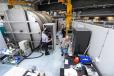
The Platypus instrument can be used to study all-manner of surface-science and interface problems, particularly related to magnetic recording materials and for polymer coatings, biosensors and artificial biological membranes.
With the screening of the popular HBO series about Chernobyl, we asked our Nuclear Analysis team for their insights on key differences between the reactor in the TV series, a Generation II RBMK power reactor and ANSTO’s state of the art research reactor OPAL.
An international team led by scientists at City University of Hong Kong has found flexible metal-organic framework (MOF) with one-dimensional channels that acts as a “molecular trapdoor” to selectively adsorb gases, such as carbon dioxide, in response to temperature and pressure changes.

The Australian Synchrotron has an on-site Guesthouse for users and AS guests.

Marianne has been at ANSTO since August 2018 and has overseen the Information Digital Services (IDS) group during this time.