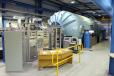
10MV ANTARES Accelerator
The 10MV tandem accelerator ANTARES is a state-of-the-art facility for ion beam analysis and accelerator mass spectrometry.


Showing 1 - 16 of 16 results
The 10MV tandem accelerator ANTARES is a state-of-the-art facility for ion beam analysis and accelerator mass spectrometry.
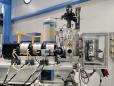
The high-energy heavy-ion microprobe is used for the characterisation or modification of material properties at depths from approximately 1 micrometre to maximum depths of up to 500 micrometres from the material surface.
New high energy ion microprobe beamline supports space research on the effects of radiation on astronauts.
A team of Melbourne researchers and international partners from Italian Instituto Nazionale de Fisica Nucleare (INFN) and CERN, who are developing radiation-hardened semiconductor chips, used the unique state-of-art high energy ion microprobe on the SIRIUS ion accelerator at ANSTO’s Centre for Accelerator Science to test a prototype radiation-resistant computer chip
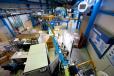
Micro-Elastic Recoil Detection Analysis (µERDA) is used to reconstruct elemental maps from scanned raster points.
Researchers developing new materials and devices that can withstand the harsh radiation environment in space are using the unique ANSTO’s capability to simulate the effects of high-energy ion irradiation on the properties and performance of these materials and devices.
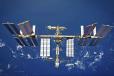
In collaboration with the French National Institute of Health and Medical Research (INSERM) and the French International Space Agency (CNES), ANSTO scientists are undertaking research on the radiobiological effects of secondary particles that are created when radiation interacts with the shielding on the International Space Station.
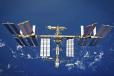
In space, without the protection of the magnetosphere, the type and dose of radiation is considerably different to what is naturally experienced on earth. However, it is the secondary particles of lower energies created when galactic and cosmic radiation interacts with shielding that is of concern for astronauts.
ANSTO is a partner on the National Space Qualification Network (NSQN) led by the Australian National University (ANU) that will transform Australia into a world-leading space centre by enhancing facilities to test payloads, components, and hardware prior to their use in harsh environments of space.

ANSTO User Meeting 2021 - Speakers

Archive of ANSTO research publications, seminars and short talks.
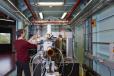
Beamtime Guide on the X-ray Fluorescence Microscopy beamline at the Australian Synchrotron.
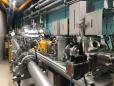
The Medium Energy- X-ray Absorption Spectroscopy beamlines provides access to XANES and EXAFS data from a bending magnet source, optimised for cutting-edge applications in biological, agricultural and environmental science in an energy range that is not currently available at the Australia Synchrotron.

The Centre for Acclerator Science operates accelerators that can be used for space radiation testing.
A team of ANSTO health researchers, staff at the Centre for Accelerator Science and Dr Melanie Ferlazzo, a postdoc from the French National Institute of Health and Medical Research (INSERM), and scientists from the French Space Agency (CNES), are collaborating on investigations to determine the impact of secondary particles on human cells using the new microprobe beamline at ANSTO’s Centre for Accelerator Science.

The BRIGHT Nanoprobe beamline provides a unique facility capable of spectroscopic and full-field imaging. NANO will undertake high-resolution elemental mapping and ptychographic coherent diffraction imaging. Elemental mapping and XANES studies (after DCM upgrade) will be possible at sub-100 nm resolution, with structural features able to be studied down to 15 nm using ptychography.