Our understanding of the atom powers ANSTO's nuclear and accelerator research techniques
Scientists at ANSTO characterise structures with atomic detail using probes such as x-rays, electrons, neutrons and ions.


Showing 281 - 300 of 973 results
Scientists at ANSTO characterise structures with atomic detail using probes such as x-rays, electrons, neutrons and ions.
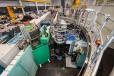
The instrument is designed to measure inelastic neutron scattering, or do neutron spectroscopy.
ANSTO is a partner on the National Space Qualification Network (NSQN) led by the Australian National University (ANU) that will transform Australia into a world-leading space centre by enhancing facilities to test payloads, components, and hardware prior to their use in harsh environments of space.
International study has revealed a clustering of charged particles in the microgravity environment of space,with implications for the development of materials and better drugs that depend on the mixing of two or more charged particles.
Understanding of the role that programmed cell death has in development.
Young physicist in training to become a surrogate inspector for Comprehensive Nuclear Test Ban Treaty Organisation.
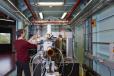
Beamtime Guide on the X-ray Fluorescence Microscopy beamline at the Australian Synchrotron.

As an experimental tool for the study of magnetism, neutron scattering is without equal in its range of applications.
ANSTO is collaborating on a project funded with an Australian Research Council linkage grant that will develop new materials and better systems for efficiently storing hydrogen gas.
ANSTO expertise focused on understanding of reduced water levels at Thirlmere Lakes in three year collaborative project
In an effort to understand why the Tongan Hunga volcano eruption was so explosive, internationally-recognised volcanologist Prof. Shane Cronin of the University of Auckland and associates rely on beamlines at the Australian Synchrotron to support comprehensive research on the Hunga event.
Research undertaken by Flinders University, the University of Cincinnati (US), Guangzhou University (China) and ANSTO has evaluated a new process to encapsulate fish oil in nanoparticles
The nandin Deep Technology Incubator at ANSTO’s Lucas Heights innovation precinct has welcomed two new members.
Dr Andrew Smith has just finished collecting ice cores and snow samples on the summit of Law Dome in Antarctica,
X-ray crystallography at the Australian Synchrotron contributed to major research findings.