

Showing 561 - 580 of 1507 results
Independent Report - Safety of Building 23
ANSTO has released the Independent Safety Review of Building 23 - Nuclear medicine production facility.
Collecting ice cores for research
Dr Andrew Smith has just finished collecting ice cores and snow samples on the summit of Law Dome in Antarctica,
MIBGen Iobenguane - 123I Injection Diagnostic
Lutetium-177 non-carrier added
ANSTO nuclear safety specialist and synchrotron scientist among Superstars of STEM
ANSTO’s Dr Joanne Lackenby and Dr Katie Sizeland have been selected 2018 Superstars of STEM as some of Australia’s most inspiring scientists, technologists and educators.
Finding a balance between killing cancer cells without damaging normal cells
Analysis of fingermarks with synchrotron techniques provide new insights
A new study by researchers from Curtin University using the infrared (IR) and X-ray fluorescence microscopy (XFM) beamlines at the Australian Synchrotron has provided a better understanding of the chemical and elemental composition of latent fingermarks.
The risks posed by stormwater runoff can be monitored with thin-film technology
A large collaboration of Australian and New Zealand researchers has established that a thin film technology can be used to monitor stormwater effectively and provides a way to translate the presence of metal contaminants into potential risks to aquatic ecosystems.
Minerals expertise advances sustainable lithium ion battery production
Innovative radioactive waste treatment technology forging ahead
International interest is building in Australia’s new multi-million-dollar radioactive waste processing facility at the Sydney campus of the Australian Nuclear Science and Technology Organisation (ANSTO).
ANSTO's Australian Synchrotron Goes Solar for a Greener Future
More than 3,200 solar panels have been installed across the rooftops of the Australian Nuclear Science and Technology Organisation’s (ANSTO) Australian Synchrotron in Clayton, offsetting enough power to light up the whole MCG for more than five years.
ANSTO congratulates the 2025 Nobel Prize in Chemistry recipients
Building knowledge of changes in uranium chemistry
A new systematic investigation of the origins of atomic structural distortions in compounds containing uranium has relevance for spent nuclear fuel .
DRAXIMAGE MACROSALB®
New technique to improve global climate models
An investigation that set out to resolve some of the uncertainty in the sources and quantities of pollutants reaching Antarctica has produced a new experimental technique to identify and characterise recently terrestrially-influenced air reaching Antarctica.
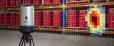
CORIS360® advanced radiation imaging solution
CORIS360 delivers fast, accurate radiation detection and imaging, making invisible radiation visible to improve safety and decision making in radioactive environments.