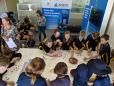
'Towering' engineering victory
Building a stable tower out of paper and designing a bionic limb were among the challenges of the Discover Engineering day, held on 11 May at ANSTO.
Showing 781 - 800 of 2187 results
Building a stable tower out of paper and designing a bionic limb were among the challenges of the Discover Engineering day, held on 11 May at ANSTO.
In October, ANSTO released the Independent Safety Review of the ANSTO Health Approach to Occupational Radiation Safety and Operational Procedures.
ANSTO undertakes a rigorous environmental monitoring program and shares expertise nationally and internationally.
Four annual awards in neutron scattering were announced at Australian Neutron Beam Users Group (ANBUG) and AINSE Neutron Scattering Symposium (AANSS) to individuals with strong links to ANSTO
General manager ANSTO Communications and Stakeholder Engagement was one of the presenters at the IAEA W4NSEC workshop
ANSTO is interested finding students to collaborate on Generation IV reactor systems.
Although Australia does not use nuclear energy for power needs, it does have the nuclear capabilities, knowledge, and expertise provided by ANSTO to ensure the national interest in nuclear matters is protected and advanced.
Radiation can be described as energy or particles from a source that travel through space or other mediums. Light, heat, and wireless communications are all forms of radiation.
Michael Druce has been awarded a Public Service Medal in the Australia Day honours for his contribution to nuclear medicine production.
ANSTO hosted an online training workshop for the FNCA (Forum for Nuclear Cooperation in Asia) project Combating Food Fraud using Nuclear Technology (CFF) in early December.
The BRIGHT Nanoprobe beamline provides a unique facility capable of spectroscopic and full-field imaging. NANO will undertake high-resolution elemental mapping and ptychographic coherent diffraction imaging. Elemental mapping and XANES studies (after DCM upgrade) will be possible at sub-100 nm resolution, with structural features able to be studied down to 15 nm using ptychography.