
Let your students lead a 30-minute Q&A session with our ANSTO experts about one of the following three topics:
- Nuclear medicines
- Nuclear techniques to study the environment
- Fission and its applications in reactors
Please ensure your students do some pre-reading about the research topic and come prepared with questions to ask during the session. We also ask that teachers send us a copy of the student questions the day before, so we can adequately prepare for your session. Teachers must be present during the session with their students.
Cost: Free

Showing 261 - 280 of 740 results
International science team paves way for fast and accurate flu diagnosis

Think Science! Competition 2026
The Think Science! competition encourages students in Years 3-10 to learn science inquiry skills in a fun and accessible way! Entry is FREE and there are generous prizes for winning schools. Any topic can be chosen, and special materials are not required.
Research highlights how to make food different and better by design
International researchers have used nuclear techniques at ANSTO - a centre for food materials science - to develop a methodology that could assist in the design of oleogel systems for food applications.
Fish lift
A lift for fish at Tallowa Dam: Study on dietary impacts.
Are landscape changes linked to loss of traditional Indigenous Australian burning techniques?
Research investigates traditional Indigenous Australian burning techniques in managing landscape and reducing fuel loads.
2020 Shorebirds Competition Summary and Results
Primary students across Australia were invited to create a public awareness poster for a threatened shorebird found in Australia for our 2020 Shorebirds Competition. In response to COVID-19, and the changes to children’s learning environments, we opened the competition early and also included categories for individual children to enter, as well as school children.
Advanced refrigeration technology on the horizon
Atomic mechanism produces colossal cooling effect in new class of materials .
The risks posed by stormwater runoff can be monitored with thin-film technology
A large collaboration of Australian and New Zealand researchers has established that a thin film technology can be used to monitor stormwater effectively and provides a way to translate the presence of metal contaminants into potential risks to aquatic ecosystems.
New technique to improve global climate models
An investigation that set out to resolve some of the uncertainty in the sources and quantities of pollutants reaching Antarctica has produced a new experimental technique to identify and characterise recently terrestrially-influenced air reaching Antarctica.
Crystallography out of this world
Nuclear power technology explored
ANSTO shared expertise on next-generation reactors and nuclear power with sustainable energy experts at the Australian Academy of Science symposium in May.
Molecular geometry and magnetism: Investigation of lanthanoid-based single molecule magnets
Meet an Expert
Creating a Feather Map to track waterbirds and inform water resource management
Leading fine particle pollution monitoring reaches 30yr milestone & looks to the future
ANSTO commenced an aerosol sampling program thirty years ago this week to characterise these pollutants and ultimately, identify their sources, which has taken it to the forefront of environmental monitoring of this type in Australia and the region.
Evidence of earliest Aboriginal occupation of Australian coast
Evidence of the earliest occupation of the coasts of Australia from Barrow Island, Northwest Australia.
Ceramisphere had its origins at ANSTO
Early research at ANSTO has contributed to development of innovative submicron particle encapsulation technology.
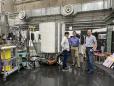
Sika - Cold Triple Axis Spectrometer
The instrument is ideally suited to study of spin and lattice dynamics, magnon and phonon dispersion relations in single crystal samples.
Physicist to become surrogate inspector
Young physicist in training to become a surrogate inspector for Comprehensive Nuclear Test Ban Treaty Organisation.