Evidence of earliest Aboriginal occupation of Australian coast
Evidence of the earliest occupation of the coasts of Australia from Barrow Island, Northwest Australia.


Showing 261 - 280 of 434 results
Evidence of the earliest occupation of the coasts of Australia from Barrow Island, Northwest Australia.
An accomplished international photographer has capture dazzling new images of one component of the main ring at our Australian Synchrotron and provided an inside view of the electron’s path when it is used.
An international collaboration of researchers has used ANSTO's facilities to find something new about the properties one of the most fundamental everyday materials, water, and answered an important scientific question.
Publications and resources from the Powder Diffraction beamline.
ANSTO is participating in a new Australian Research Council (ARC) Centre of Excellence for Indigenous and Environmental Histories and Futures (CIEHF) to be headquartered at James Cook University (JCU) that aims to bring Indigenous and environmental histories to the forefront of land and sea management.
ANSTO participates in nuclear medicine congress
International neutron scattering award for retired head of former Bragg Institute, Prof Robert Robinson
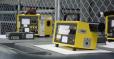
ANSTO offers reliable and traceable calibration services for radiation survey meters, contamination monitors and electronic personal dosimeters.
Routine transport of spent nuclear fuel
Virtual activities celebrating the benefits of nuclear science and technology held for National Science Week

Publications, posters and conference presentations for fire impacts reconstructed from a southwest Australian stalagmite.

Role at ANSTO
During the scheduled shutdown of the OPAL multi-purpose reactor, an ANSTO engineering and project team has installed a new safety shutdown instrumentation and control system (I&C).


Andrew Peele was appointed Group Executive for ANSTO Nuclear Science and Technology in July 2021 and was Director of the Australian Synchrotron from 2013 -2021. He is an adjunct Professor of Physics at La Trobe University.

Consumers want to know that the foods they consume provide health benefits. Food materials science can monitor changes during digestion as well as assist in the development of low-fat products.
Research will change understanding of Australian Aboriginal rock art found in rock shelters of the Kimberley and its relationship to a changing landscape
An international research team has discovered how a bacterial toxin, known as Ssp, is capable of entering and killing a wide range of living cells, including human cells using the Australian Synchrotron.