

Showing 321 - 340 of 2448 results
Evaluating the impact of nanomaterials on health and the environment
ANSTO has put together a robust multidisciplinary approach to understanding the impacts of nanomaterials, investigating a common food additive, E171 titanium dioxide, used primarily as a colouring agent in everyday foods.
Shutting down a nuclear reactor is a slow and methodical process: A closer look
The shutdown of a nuclear reactor can be done manually by an operator following a well-established operating procedure.
New publication showcases survival and resilience of Indigenous cultural knowledge
A new publication The First Inventors, captures the story of how Indigenous knowledge shaped the Australian continent has been published. Based on the SBS and Channel 10 TV series, The First Inventors, it takes readers on a journey through 65,000 years of innovation, diplomacy and design.
Fossilised remains of Ice Age top predator dated with radiocarbon
ANSTO and the University of Singapore sign Australian Synchrotron Agreement
ANSTO and the National University of Singapore have signed an agreement to enable Singapore researchers to access ANSTO’s state-of-the-art beamline facilities at the Australian Synchrotron.
ANSTO scientists and engineers featured in Careers with STEM Science
ANSTO scientists have been featured in the new issue of Careers with STEM Science, a publication produced for high school students, undergraduates and grads, careers advisors, teachers and parents to discover careers and study paths.

Elements in the 21st Century 2024 - Summary and Results
Netflix series 'Radioactive Emergency' reviewed by ARPANSA and ANSTO radiation experts
Blake Orr from ARPANSA review the Netflix series Radioactive Emergency.
Research reveals little water connectivity between coal seam gas and aquifers
COVID-19 proof, healthy workstation wins ACS COVID-19 Online Hackathon
Australia and United States strengthen nuclear security collaboration with MoU
Although Australia does not use nuclear energy for power needs, it does have the nuclear capabilities, knowledge, and expertise provided by ANSTO to ensure the national interest in nuclear matters is protected and advanced.
Radiocarbon dating and stable isotope analysis contribute to Antarctic research
Study shows for the first time that vegetation in the Windmill Islands, East Antarctica is changing rapidly in response to a drying climate.
Research confirms that echidnas and platypuses descended from an aquatic ancestor
A paper led by researchers at the University of New South Wales (UNSW) published in the PNAS last year has confirmed the theory that echidnas and platypuses descended from an aquatic ancestor with fossil evidence.
Ultra-sensitive accelerator technique traces the rise and fall of a giant Himalayan glacier
ANSTO has supported a new study published in Quaternary Science Reviews that dates the dramatic collapse of one of the largest glaciers ever documented in the Himalayas. The findings overturn a long-held assumption about what sustains wet-climate glaciers.
A closer look at the scientific power of nuclear and accelerator techniques
In Part 2 of our series exploring the world of nuclear science and technology at ANSTO, we share more detailed information about the nuclear scientist’s toolkit.
Creating a Feather Map to track waterbirds and inform water resource management
New imaging approach using live plants will benefit agriculture and environment
A cross-disciplinary team has used laboratory-based and synchrotron-based infrared spectroscopy imaging techniques to monitor the waxy surface of living plant leaves in real-time to gain insights into plant physiology in response to disease, biological changes or environmental stress.
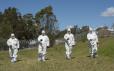
ANSTO in consultation with partners has developed a specialised training course to support first responder agencies in ensuring personnel are effectively prepared for response to radiological and nuclear emergency situations.
Sydney