Progress on organic thin films for solar cells
Modifications to promising novel non-fullerene small molecule acceptor in organic thin film for solar cells demonstrates improved power conversion efficiency.


Showing 321 - 340 of 395 results
Modifications to promising novel non-fullerene small molecule acceptor in organic thin film for solar cells demonstrates improved power conversion efficiency.
Highlighting the contribution of four inspirational ANSTO leaders on International Women's Day.
The need for a smaller, more transportable version of ANSTO’s 1500-litre atmospheric radon-222 monitor, and with a calibration traceable to the International System of Units, prompted the team to develop a 200-litre radon monitor that would meet those needs.
Progress on a more environmentally-friendly production method for hydrogen peroxide.
In a world-first study, Australian environmental scientists have used cave stalagmites as a record of groundwater replenishment over time, that showed the current level of rainfall recharging groundwater in southwest WA is at its lowest for at least the last 800 years.

Billions of tonnes of iron ore tailings are generated each year from the mining industry. Converting these toxic tailings into soil-like materials which can develop and sustain plant and microbial communities is critical for mine site remediation and improved environmental outcomes.
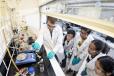
ANSTO Big Ideas encourages students to creatively communicate the work of an Australian scientist, and explain how their work has inspired them to come up with a Big Idea to make our world a better place. This competition is intended to engage and support Australian students in years 7-10 in Science and encourage them to pursue studies and careers in STEM.

ANSTO’s National Deuteration Facility has been providing high-quality deuterated lipids used in the construction of cell membrane models to support research that improves our understanding of how the virus interacts with elements of the cell membrane, a relatively new area of investigation.
ANSTO has hosted an event to launch a new Dharawal language learning resource for primary students at the nandin innovation centre.

ANSTOs capabilities are ideally suited for these investigations relating to quantum technologies.
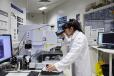
The Infrared Microspectroscopy beamline combines the high brilliance and collimation of the synchrotron beam through a Bruker V80v Fourier Transform Infrared (FTIR) spectrometer and into a Hyperion 3000 IR microscope to reach high signal-to-noise ratios at diffraction limited spatial resolutions between 3-8 μm.
Dr Anna Paradowska has been appointed as a Conjoint Professor of Practice in Advanced Structural Materials at the University of Sydney.
The Titan Krios cryo-electron microscope reveals the inner workings of life at the cellular level.
Phenomenon predicted by Nobel Prize recipient
ANSTO is participating in a new Australian Research Council (ARC) Centre of Excellence for Indigenous and Environmental Histories and Futures (CIEHF) to be headquartered at James Cook University (JCU) that aims to bring Indigenous and environmental histories to the forefront of land and sea management.
The mining industry is set to benefit from a new Australian capability that uses a nuclear scanning technique to detect the presence of precious metals and strategic minerals in a core sample.