
Technical Officer


Showing 41 - 60 of 112 results

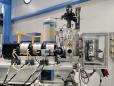
The high-energy heavy-ion microprobe is used for the characterisation or modification of material properties at depths from approximately 1 micrometre to maximum depths of up to 500 micrometres from the material surface.
This joint initiative at ANSTO has developed a new capability: solid surface radiolabelling to evaluate Auger emitting sources for next-generation targeted therapy.
Collaboration investigates a promising new nanoparticle for potential use in combination with other therapies for brain cancer

X-ray fluorescence scanner is a powerful analytical tool for environmental studies.
A team of researchers from ANSTO and University of Technology Sydney have set a record by conducting thin film experiments at 1100 degrees C.

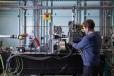
Data analysis on the X-ray fluorescence microscopy beamline at the Australian Synchrotron.
Doping with transition metals produced stability in bismuth oxide.
Doping with transition metals produced stability in bismuth oxide.
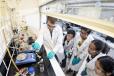
ANSTO Big Ideas encourages students to creatively communicate the work of an Australian scientist, and explain how their work has inspired them to come up with a Big Idea to make our world a better place. This competition is intended to engage and support Australian students in years 7-10 in Science and encourage them to pursue studies and careers in STEM.

Analysing the microstructure of paracetamol using synchrotron infrared optical technique provides insights.
New oxygen ion conducting material for use in solid oxide fuel cells and other devices
Advanced X-ray techniques have revealed new structural details about the specific arrangement of atoms in conjugated polymers, an important class of materials that are used in LEDs, organic solar cells, transistors, sensors and thermoelectric power devices.

A world-class national research facility that uses accelerator technology to produce a powerful source of light-X rays and infrared radiation a million times brighter than the sun.
The Advanced Diffraction and Scattering beamlines (ADS-1 and ADS-2) are two independently operating, experimentally flexible beamlines that will use high-energy X-ray diffraction and imaging to characterise the structures of new materials and minerals.