Where do nano particles go once they enter the body? ANSTO scientist helps shape new OECD guidance
ANSTO scientist Dr Paul Callaghan helped develop new OECD guidance for studying how nanoparticles are absorbed, distributed and cleared by the body.


Showing 541 - 560 of 887 results
ANSTO scientist Dr Paul Callaghan helped develop new OECD guidance for studying how nanoparticles are absorbed, distributed and cleared by the body.
nandin member, SVSR, report on their proof-of-concept for a reusable Graphene Oxide (GO) membrane to capture waste water vapours from ageing sewerage systems.
A large international collaboration has developed a straightforward and cost-effective synthesizing approach using a 3D printing technique to produce single atom catalysts (SACs)—potentially paving the way for large scale commercial production with broad industrial applications.
New class of single atoms catalysts for carbon nanotubes characterised.

ANSTO has safely managed its radioactive waste for over 60 years. Waste is managed in accordance with national and international standards.
ARPANSA has given ANSTO approval to begin testing the neutron reflectometer, Spatz
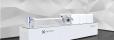
An instrument used to study any materials with structure of the length scale 1-100nm.

ANSTO is committed to monitoring its environmental performance and providing the community with accurate information about it. We also publish live meteorological data from our 49m Lucas Heights weather tower every 15 minutes.

Most fingermark research has largely focussed on the organic material in residues. Consequently, a gap in fundamental knowledge exists when it comes to inorganic components such as metals.
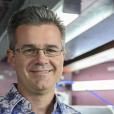
Dr Joseph Bevitt is a senior instrument scientist on the Dingo radiograph/tomography/imaging station, and scientific coordinator for the Australian Centre for Neutron Scattering.
Strategic partnership with the University of Sydney expanded to continue a long history of research collaboration.

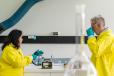
Enhancing safety of trailer trucks among research projects